AI Across the FMCG Value Chain: Marketing, Retail, and Enterprise in Sync
A nationwide building-materials and fast-moving-consumer-goods company built an AI application system covering marketing, retail operations, and enterprise functions—linking data-driven decision-making, store-floor intelligence, and organizational content production into a closed loop that significantly improved collaboration and market responsiveness.
A nationwide building-materials and fast-moving-consumer-goods company faced a familiar dilemma: headquarters held extensive consumer insights and market data, yet frontline store managers and sales associates struggled to access timely decision support; marketing planned rich promotional campaigns, but terminal execution varied widely in standardization; internal knowledge and content production lagged behind business expansion, slowing innovation response. By building an AI application system spanning marketing, retail operations, and enterprise functions, the company achieved systematic upgrades across value creation, value delivery, and value extraction—significantly improving business collaboration and market responsiveness.
Background and Pain Points
In the FMCG and building-materials industries, companies typically manage large dealer networks, dense retail stores, and complex supply chains. This company encountered four core pain points on its digitalization journey:
Weak data-driven capabilities. The company possessed sales data, member data, channel inventory data, and more, but information was scattered across different systems without a unified analytics platform. When marketers conducted consumer insights, they had to manually extract information from multiple reports, leading to long analysis cycles that could not support rapidly iterating market decisions.
Low business collaboration efficiency. Marketing strategies, product selling points, and promotional plans formulated at headquarters degraded layer by layer as they reached frontline stores. Store managers and sales associates held inconsistent understandings of new-product information and campaign rules, creating noticeably different customer experiences across stores and making brand-image unity difficult to achieve.
Uneven frontline service capabilities. Store staff varied widely in experience and skill. The sales scripts and service workflows of top performers could not be systematically replicated. New hires faced long ramp-up periods, and overall store service capacity showed a pronounced "head-effect" imbalance.
Slow innovation response speed. As market competition intensified, the company needed to rapidly produce marketing copy, training materials, and product handbooks. Traditional content production relied on specialist teams, and the journey from request to deliverable often took weeks—far too slow for market rhythms.
What We Did
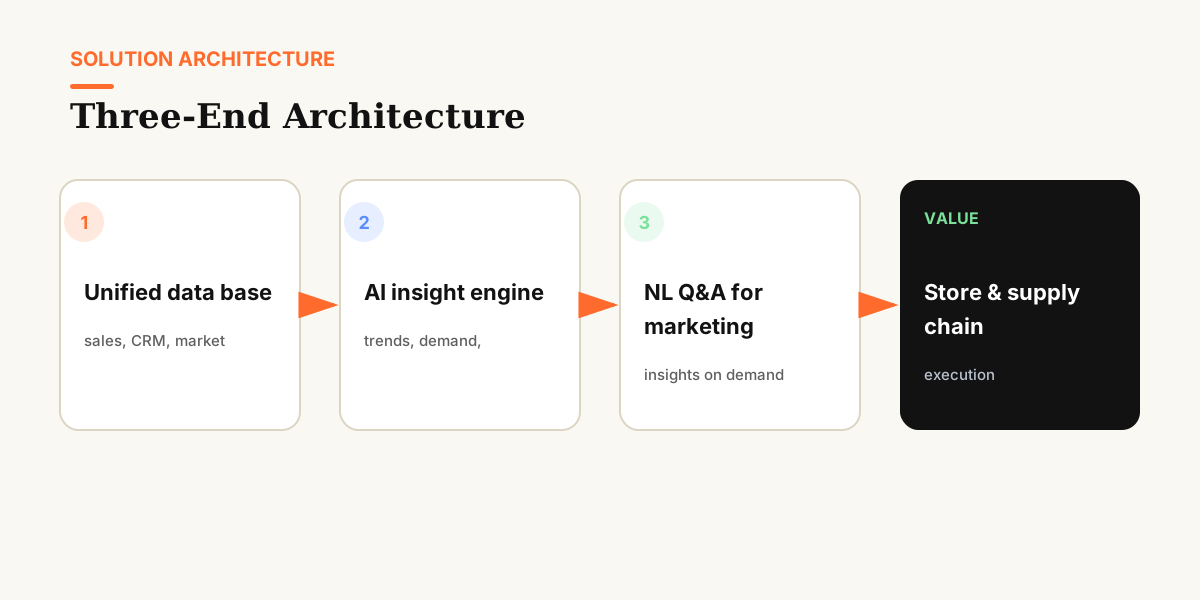
The project team partnered with the company's digitalization department to design and deploy an AI application system covering marketing, retail, and enterprise functions, organized around the three dimensions of value creation, value delivery, and value extraction.
Marketing: Consumer behavior insights and experience optimization
At the value-creation level, the team first connected the company's sales system, member system, and third-party market data to build a unified consumer-insight data foundation. Through an AI analytics engine, the system automatically identified consumption trends, predicted regional demand fluctuations, and analyzed price sensitivity and category preferences across customer segments. Marketers could ask questions in natural language, such as "What are the characteristics of repeat buyers for the tile category in South China over the past three months?" and receive structured insight conclusions and visual charts in real time. This shifted marketing strategy from experience-driven to data-driven, allowing product development and supply-chain scheduling to adjust proactively based on forecasts.
Retail: Intelligent empowerment for store managers, sales associates, and dealers
At the value-delivery level, the team developed an intelligent empowerment toolkit for frontline stores. Store managers could use a mobile app to view real-time store rankings, inventory alerts, and best-practice cases. Sales associates could look up product selling points, pairing recommendations, and promotional information during customer conversations, while the system recommended personalized talking points based on customer profiles. For dealers, an AI assistant provided ordering recommendations, inventory-optimization plans, and regional competitor dynamics to improve operational efficiency. By converting headquarters' knowledge assets into instantly accessible intelligent services at the front line, terminal execution standardization improved markedly, and the uneven-service-capacity problem was alleviated.
Enterprise: Intelligent content generation and organizational capability building
At the value-extraction level, the team deployed an internal content-generation platform. Marketing could use it to rapidly generate promotional copy, social-media posts, and campaign-planning drafts; training could automatically produce product-knowledge handbooks, sales-skills courses, and assessment question banks; legal and compliance teams could also leverage AI to assist in contract and policy review. The content platform was connected to the corporate knowledge base, ensuring that generated content matched brand tone and compliance requirements. This compressed content-production cycles from weeks to hours while allowing organizational knowledge to accumulate and be reused, noticeably improving new-hire training efficiency.
Building a sustainable intelligent operations system
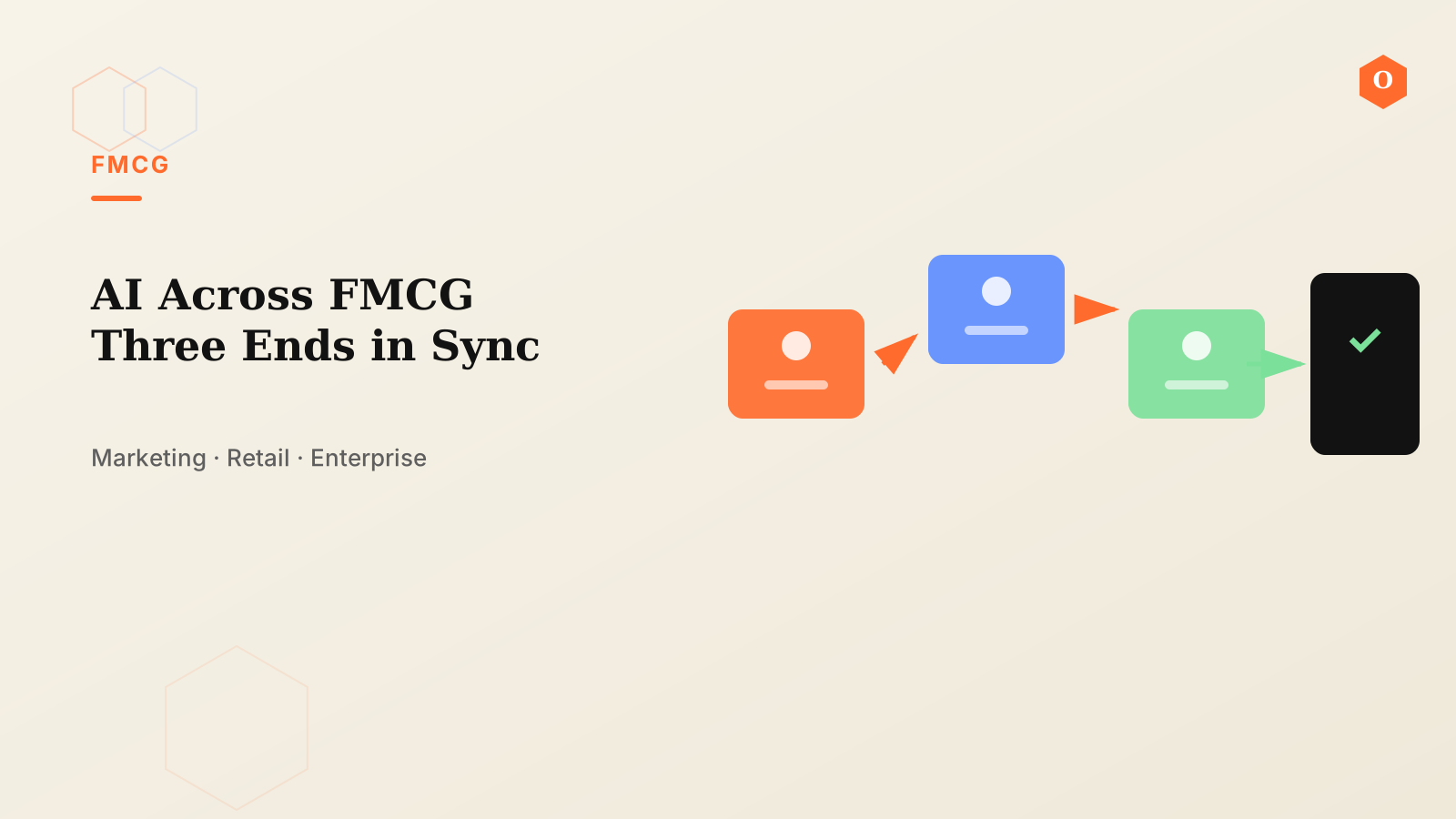
The three endpoints' AI applications did not operate in isolation. They were interlinked through a unified data foundation. Marketing consumer insights pushed in real time to the retail sales-associate assistant; frontline sales feedback flowed back to marketing for strategy tuning. Enterprise-generated training content sank directly to the retail floor, while actual execution data from the floor fed back into enterprise content optimization. This closed loop allowed the company to gradually build a sustainable intelligent operations system rather than remaining at the level of isolated point tools.
Results on the Ground
After two quarters of operation, the company saw quantifiable changes across multiple dimensions:
- Marketing decision cycles shortened by roughly 60%. With real-time insights from the unified data foundation, marketing teams could close the loop from market discovery to strategy deployment within one week, compared with 2–3 weeks previously.
- Frontline store sales conversion rates rose by an average of 15%–20%. After the intelligent empowerment tools went live, product-knowledge mastery and service standardization among sales associates improved, and customer-satisfaction scores for "professionalism" rose noticeably.
- Content production costs dropped by over 70%. Average production time for high-frequency content such as marketing copy and training materials shrank from 5–7 days to under one day, and the marketing department's content output frequency increased more than threefold.
- New-hire training cycles compressed by 40%. With the intelligent training platform and knowledge base, newly hired sales associates could master core product knowledge and standard service workflows in less time, reaching independent floor readiness sooner.
Lessons Learned: From Project to OntiCards
The project's biggest takeaway is that enterprise AI adoption cannot stop at point tools; it must connect the full chain of "data → insight → action → feedback." Many companies deploy analytics in marketing, mobile apps in retail, and content platforms internally, but the three operate independently, data cannot flow, and the result is three isolated systems.
The project's architecture—a unified data foundation, three-endpoint intelligent applications, and a closed-loop feedback mechanism—was later abstracted into OntiCards' "enterprise full-chain intelligent operations" solution. In OntiCards, the data-card layer can connect to existing ERP, CRM, POS, and other systems, unifying scattered data assets under consistent governance; the query Agent gives marketing and operations staff natural-language access; and professional Agents can be customized for scenarios such as frontline empowerment, content generation, and training support. All Agents share the same data cards and terminology definitions, ensuring information consistency from headquarters to the store floor.
For FMCG, retail, or building-materials enterprises pursuing digital transformation, OntiCards offers a low-friction path from data governance to intelligent-application deployment. Reach out at hello@onticards.com or visit our product and solutions pages to learn more.