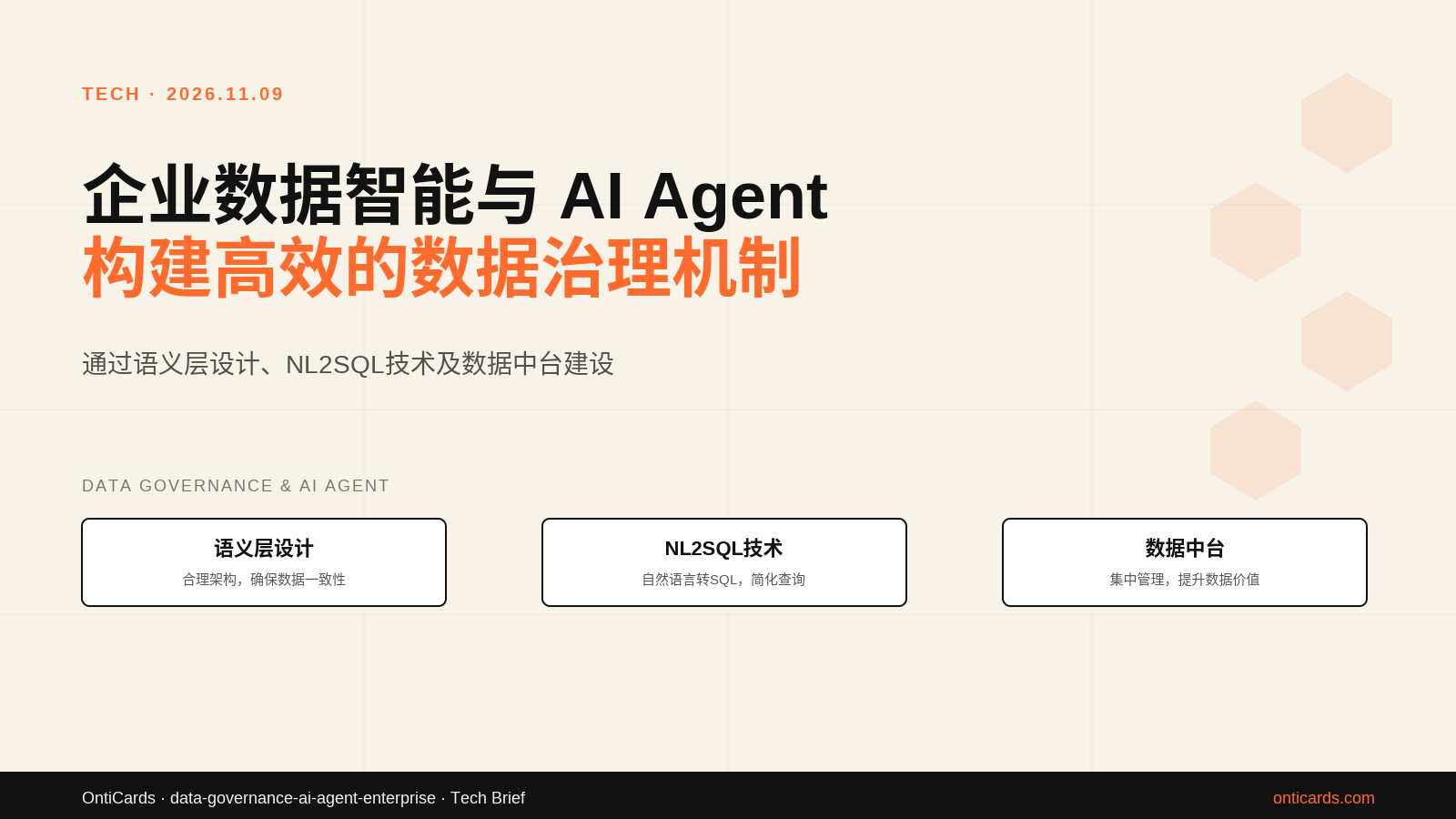
Design of Semantic Layer for Enterprise Data Intelligence and AI Agents: Enhancing Data Governance and Collaboration Efficiency
This article explores how to improve the efficiency of enterprise data governance and promote collaboration among different departments through reasonable semantic layer design. The semantic layer not only enhances the consistency and accuracy of data but also improves the explainability of data and the ability for cross-departmental collaboration.
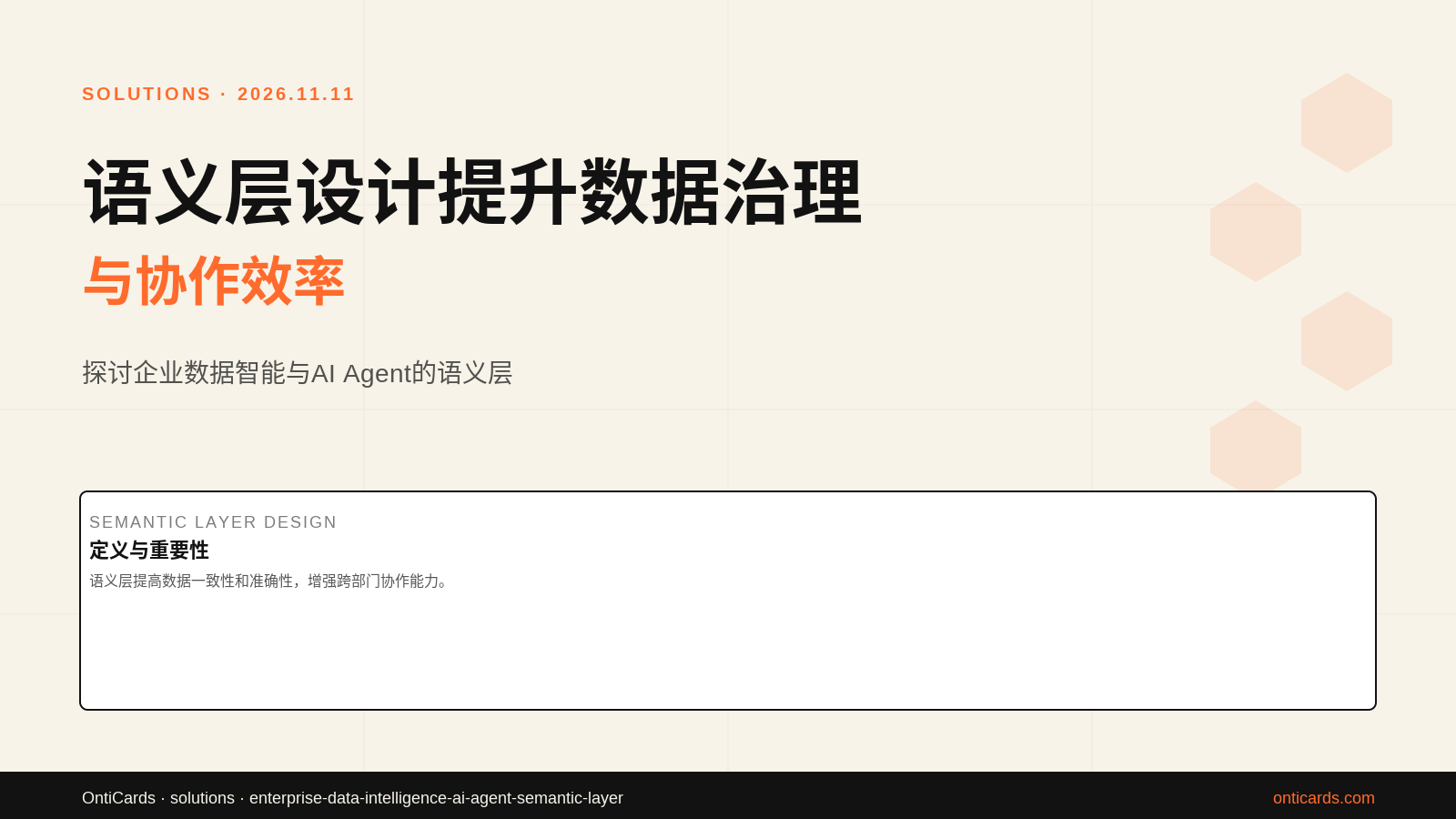
Semantic Layer Design for Enterprise Data Intelligence and AI Agents: Achieving Efficient Data Governance and Collaboration
In the practice of enterprise data intelligence, the design of the semantic layer is crucial. It not only determines the consistency and accuracy of data but also directly affects the reliable operation of AI agents and the efficiency of automated processes. This article will explore how to improve the efficiency of enterprise data governance and promote collaboration between different departments through reasonable semantic layer design.
Basic Concepts and Importance of the Semantic Layer
Definition of the Semantic Layer
The semantic layer is an abstract method of representing data that simplifies complex data structures into more understandable and usable models. This model defines clear data relationships and business logic, allowing data consumers (such as analysts and business personnel) to query and analyze in a natural language manner without needing to deeply understand the complexity of the underlying database.
Importance of the Semantic Layer
- Improve Data Consistency: By unifying data definitions and standards, it ensures consistent data metrics across different systems and departments.
- Lower Technical Barriers: Enables non-technical personnel to easily access and use data, thereby increasing data utilization.
- Enhance Data Explainability: Through clear data relationships and business logic, data results become more explainable and credible.
- Support Cross-Departmental Collaboration: Provides a shared data view, promoting communication and collaboration between different departments.
Specific Application Scenarios
When collaborating with manufacturing enterprises, a common situation is that the same report does not match between financial and production metrics. By introducing the semantic layer, these two sets of metrics can be unified, ensuring data consistency. For example, in a project at a manufacturing company, the finance department and the production department had different definitions of "cost," leading to frequent data inconsistencies during monthly settlements. By defining the calculation method and metrics for "cost" through the semantic layer, this issue was resolved.
Design Principles of the Semantic Layer
Data Standardization
- Unified Terminology: Ensure that all departments and systems use the same terms and definitions.
- Standardized Data Formats: Define uniform data formats and field types to avoid errors due to format inconsistencies.
- Establish Metadata Management: Use a metadata management system to record the source, definition, change history, and other information about the data, making it easier to track and maintain.
Business Logic Mapping
- Clear Business Rules: Clearly map business rules and logic into the data model to ensure consistent data processing.
- Flexibility for Changes: Consider changes in business needs during design, so the semantic layer can quickly adapt to new business rules.
- Multi-Dimensional Perspective: Provide multi-dimensional data views to meet the needs of different departments and roles.
Technology Selection and Implementation
- Choose the Right Tools: Select appropriate semantic layer tools based on the actual situation of the enterprise, such as the data middleware solutions provided by OntiCards.
- Integrate Existing Systems: Ensure that the semantic layer can seamlessly integrate with existing data platforms and systems, reducing migration costs.
- Continuous Optimization: Regularly evaluate and optimize the design of the semantic layer to ensure it always meets business needs and technological developments.
Specific Application Scenarios
In a case study of a retail company, different departments had varying definitions of "sales," leading to inconsistent data analysis results. By introducing the semantic layer, the calculation method for "sales" was clarified, and the metrics were unified across departments. This not only improved data consistency but also enhanced collaboration efficiency between departments.
Integration of the Semantic Layer with AI Agents
The Semantic Layer as a Data Contract for AI Agents
- Data Constraints: The semantic layer defines the structure and relationships of the data, providing a clear data contract for AI agents, ensuring their operations are consistent and trustworthy.
- Natural Language Understanding: Through NL2SQL or Text-to-SQL technology, the semantic layer enables AI agents to better understand user intent and generate accurate query statements.
- Automated Processes: Based on the semantic layer, AI agents can implement more complex automated processes, improving work efficiency.
Impact of the Semantic Layer on AI Agents
- Improved Accuracy: By unifying data definitions and standards, it reduces data ambiguity and improves the accuracy of AI agent queries and operations.
- Enhanced Explainability: The semantic layer makes AI agent operations more explainable, making it easier for users to understand and trust.
- Support for Complex Tasks: The semantic layer provides rich data relationships and business logic, enabling AI agents to handle more complex tasks.
Specific Application Scenarios
In a project at a bank, AI agents were used for automated report generation. By introducing the semantic layer, the calculation methods and metrics for various reports were clarified, allowing the AI agents to accurately generate the required reports. Additionally, the semantic layer enabled the AI agents to better understand natural language queries from users, enhancing the user experience.
Challenges and Solutions in Implementing the Semantic Layer
Implementation Challenges
- Difficulty in Data Standardization: There may be significant data differences between different systems and departments, and unifying standards requires time and resources.
- Complexity of Business Logic: Business rules and logic can be very complex, and mapping them to the semantic layer requires in-depth understanding and design.
- Technology Selection and Integration: Choosing the right tools and integrating them into existing systems may encounter technical difficulties and compatibility issues.
Solution Strategies
- Phased Implementation: Gradually advance the design and implementation of the semantic layer, starting with key business modules and gradually expanding to others.
- Cross-Departmental Collaboration: Form cross-departmental teams to jointly participate in the design and implementation of the semantic layer, ensuring that the needs of all parties are met.
- Training and Support: Provide adequate training and support to help users and administrators master the use of the semantic layer.
- Continuous Optimization: Regularly evaluate the effectiveness of the semantic layer and make adjustments and optimizations based on feedback to ensure it always meets business needs.
Specific Application Scenarios
In a project at a financial company, the implementation of the semantic layer faced several challenges. First, data standardization was difficult due to inconsistent data metrics across different systems. By implementing in phases, the data metrics for key business modules were gradually unified. Second, the complexity of business logic required cross-departmental collaboration and detailed business rule梳理,最终成功将业务逻辑映射到语义层中。
结论
语义层的设计是企业数据治理中的关键环节,它不仅提高了数据的一致性和准确性,还促进了不同部门间的协作。通过合理的语义层设计,企业可以更好地利用AI Agent,实现自动化流程和高效的业务操作。尽管实施过程中会遇到一些挑战,但通过分阶段实施、跨部门协作和持续优化,这些问题都可以得到有效解决。
参考来源
- 本文基于公开行业资料与作者实践经验整理。(无外部引用)
## Conclusion

The design of the semantic layer is a critical component in enterprise data governance. It not only enhances the consistency and accuracy of data but also promotes collaboration between different departments. Through reasonable semantic layer design, enterprises can better utilize AI agents to achieve automated processes and efficient business operations. Although there are some challenges during implementation, these can be effectively addressed through phased implementation, cross-departmental collaboration, and continuous optimization.

## References

- This article is based on publicly available industry information and the author's practical experience. (No external citations)