HK EDB EMM Platform: Classroom Video Auto-Analysis and Faster Teaching Feedback
By combining AI video analysis with a data-middle-platform backbone, the Hong Kong Education Bureau's EMM e-learning platform lets teachers pinpoint instructional clips without watching entire recordings—boosting lesson-search and prep efficiency by an order of magnitude.
The Hong Kong Education Bureau's EMM (e-Learning Management & Monitoring) platform hosts a growing archive of classroom video recordings. As the collection expanded, teachers faced a common challenge during lesson preparation: how to quickly locate video segments relevant to their current topic from a massive library? Traditional methods relied on keyword search or manual browsing, the former missing semantically related content and the latter consuming hours. By introducing AI video-analysis technology and a data-middle-platform architecture, the EMM platform achieved automatic tagging, semantic search, and structured analysis of classroom videos. Teachers' time to locate instructional material dropped from hours to minutes, and the feedback loop for teaching improvement accelerated significantly.
Background and Pain Points
Three core pain points defined the EMM platform's challenges:
Difficult search with imprecise content targeting. The platform held classroom recordings spanning multiple subjects and grade levels, yet traditional directory-based management or keyword matching could not capture the deep semantics of video content. A mathematics teacher looking for a segment on "properties of quadratic-function graphs" might miss equally relevant content where the instructor verbally described "parabola opening direction."
High time cost forcing teachers to watch entire videos. Without intelligent analysis tools, teachers often had to watch a full lesson—or repeatedly scrub through timelines—to judge whether a video suited their class. Screening a single lesson could take 30 minutes or more.
Curriculum disconnect leaving resources underutilized. After upload, many videos lacked automatic linkage to the Education Bureau's curriculum standards database. Teachers struggled to gauge how well a clip aligned with their current teaching progress, leaving high-quality resources dormant in the archive.
What We Did
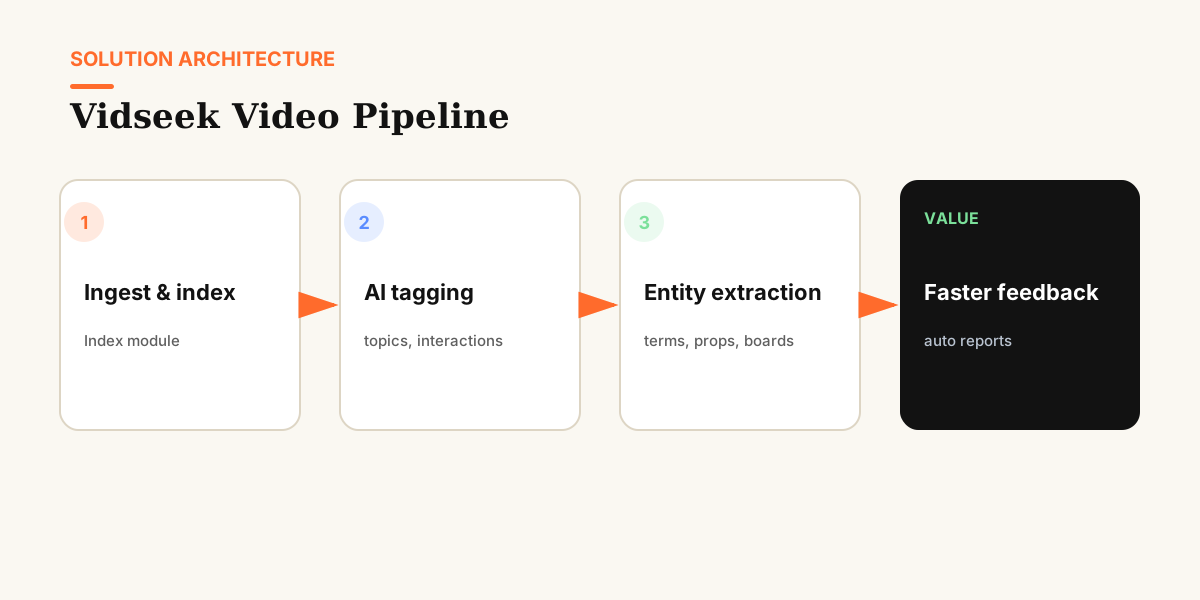
The project unfolded in two phases. Phase one used our video-analysis product Vidseek (https://ai-vidseek.com/) to deeply parse video content. Phase two used OntiCards to ingest the structured output into a data middle platform, forming a queryable, interlinked data foundation for teaching improvement.
Phase One: Vidseek Video Content Parsing
Vidseek delivers four core capabilities: video indexing (Index), semantic search (Search), structured entity extraction (Entities), and multi-dimensional analysis views (Analyze). The project team bulk-ingested classroom recordings from the EMM platform into Vidseek index libraries, where the system performed frame-by-frame analysis of speech, visuals, and on-screen text:
- AI video tagging: The system automatically identified instructional themes, key knowledge points, and instructional-interaction nodes (such as questioning, group discussion, and blackboard segments), generating automated tags. For example, a 40-minute mathematics lesson might be tagged with multi-level labels like "quadratic functions—graph properties—teacher-student interaction—worked examples."
- Structured entity extraction: Vidseek's Entities module extracted key entities from the video, including subject terminology, teaching props, core concepts, and primary teacher-student interaction behaviors—converting originally unstructured video information into searchable, relatable fields.
- Semantic search: Based on deep understanding of video content, the system lets teachers describe instructional needs in natural language. A query like "grade-nine classroom introduction segment on parabola applications" transcends literal keyword matching and directly returns semantically relevant passages with timestamps.
Phase Two: OntiCards Data-Middle-Platform Integration and Multi-Dimensional Analysis
Once Vidseek parsing was complete, the resulting structured fields—including video tags, knowledge-point mappings, interaction-behavior records, and timestamp locations—were imported into an educational data middle platform through OntiCards' data-ingestion layer. OntiCards played three critical roles:
- Data card standardization: Parsing results were defined as standardized data cards with uniform field semantics (such as "instructional theme," "interaction type," and "knowledge coverage"), ensuring consistent definitions for downstream querying and analysis.
- Curriculum-database linkage: Through relationship mapping, video cards were associated with the Education Bureau's curriculum standards database, enabling automatic alignment between video resources and the syllabus. After a teacher selects subject, grade, and topic, the system returns not only relevant video clips but also complete lesson-plan suggestions mapped against curriculum standards.
- Teaching-improvement data foundation: Once connected to the middle platform, classroom segments, key behaviors, and instructional interactions became queryable, interlinked assets. Teaching-research managers could perform multi-dimensional analysis by subject, grade, or teacher—for example, analyzing how much time different classrooms devote to a given knowledge point, or identifying correlations between high-frequency interaction patterns and academic outcomes.
Functionality Designed for Three Stakeholder Groups
On the EMM platform, AI capabilities are organized into modules serving teachers, students, and the Education Bureau:
- Teacher side: AI video search delivers precise video materials and curriculum suggestions; an AI toolbox supports worksheet generation and lesson planning; an AI learning assistant helps teachers summarize lessons and refine plans.
- Student side: The AI learning assistant provides video summaries, mind maps, key-point abstracts, mini-quizzes, note organization, and worked examples—helping students use classroom videos for after-class review and self-directed learning.
- Education Bureau side: AI video tagging provides global content-management capabilities. Administrators can use the tag system to monitor knowledge-point coverage and resource distribution across the platform, informing data-driven decisions on regional instructional-resource allocation.
Results on the Ground
After the upgrade, quantifiable improvements emerged in video-search efficiency, lesson-prep quality, and data-driven teaching research:
- Teacher time to locate instructional videos fell from an average of 30–60 minutes to under 5 minutes. Semantic search and automatic tagging eliminated the need to watch videos segment by segment.
- Curriculum-alignment accuracy rose markedly. Through automatic cross-checking against the curriculum standards database, returned video segments matched teaching topics far better than traditional keyword search. Teachers reported that resources were now "findable and usable."
- Classroom video utilization increased. Teaching-research statistics showed that after AI analysis was introduced, retrieval and citation frequency of archived videos grew several-fold, reactivating previously dormant resources.
- The teaching-feedback loop accelerated. Classroom interaction data extracted by Vidseek and analyzed through the OntiCards middle platform gave teaching-research teams quantitative feedback on classroom structure and teacher-student interaction ratios within hours after class. Previously, such analysis required manual classroom observation and handwritten logging, with cycles measured in days.
Lessons Learned: From Project to OntiCards
This project's distinctive value lies in proving that video analysis must be coupled with a structured data middle platform to move from "understanding video" to "acting on insight." Vidseek solves the parsing of unstructured video content, but if parsing results remain in isolated data tables, teaching-research managers still cannot ask cross-dimensional questions or link video insights with academic and curriculum data.
OntiCards' data-card layer fills this gap precisely: it transforms Vidseek's segment tags, behavior entities, and timestamps into data cards carrying business semantics and relationship definitions. Once connected to the middle platform, these cards can be queried in relation to enrollment data, exam scores, and syllabus cards. This "video parsing → card structuring → middle-platform linkage" pipeline later became OntiCards' standard deployment pattern for multimedia educational-asset scenarios.
For any institution that has accumulated large volumes of instructional videos, meeting recordings, or training materials, this pipeline offers a proven reference: extract content semantics with video-analysis tools, complete structural governance with a data-card layer, and achieve unified cross-modal, cross-business querying through a data-agent interface.