Decoding Qwen3.8-Flash-Next: How 51B N-gram Embedding Reshapes the Inference Stack
Beyond the widely-misquoted 58B figure, the 51B N-gram Embedding module is the real story. We unpack its sparse-lookup architecture and address three persistent misconceptions — it is not built-in RAG, it does not retire RAG, and it will not deliver a step-change in general capability. A more measured engineering read on what this release actually changes.
The Qwen team has officially open-sourced Qwen3.8-Flash-Next, a preview of the next-generation Qwen4 architecture. The headline feature — a 51B N-gram Embedding module — has triggered broad discussion across the industry. But as conversation accelerates, misreadings multiply: the "58B parameter" rumor, "built-in RAG replaces retrieval," "RAG is dead," and "general-capability leapfrog" are all circulating with little grounding in the actual paper.
This post returns to the source — the arXiv paper (arXiv:2608.30320), the official Qwen blog, and the published tech report — and offers a calmer engineering read.
1. Core Architecture: What Is 51B N-gram Embedding?
1.1 The Parameter Count, Corrected
First, a widely-circulated detail that needs to be corrected: the module is 51B parameters, not the 58B that has been passed around online.
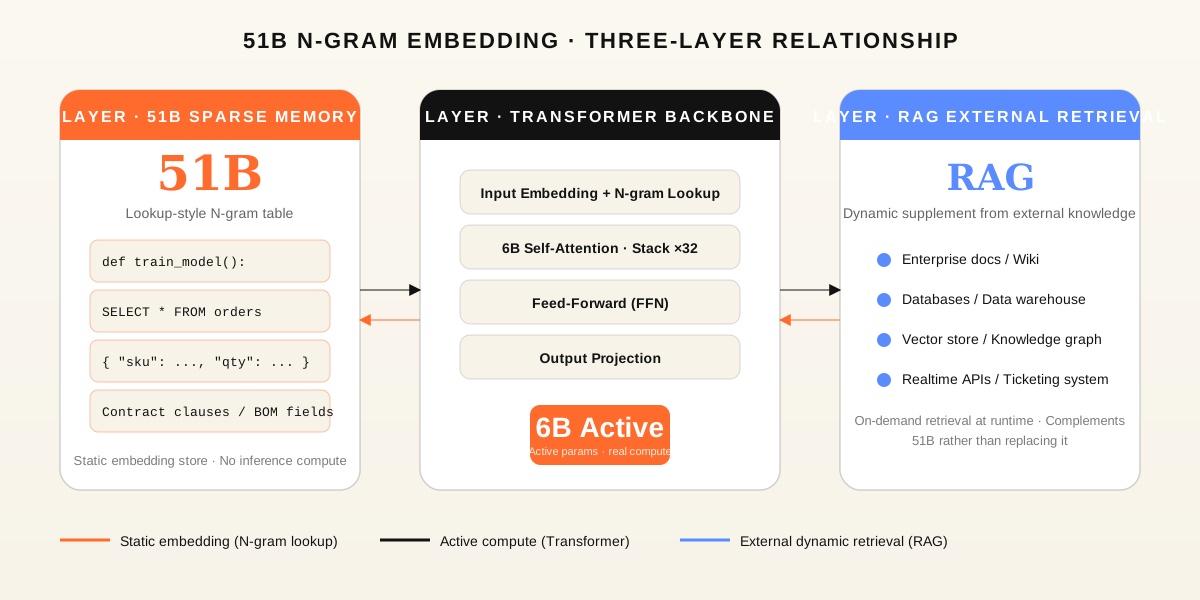
According to the Qwen team's arXiv paper (arXiv:2608.30320), Qwen3.8-Flash-Next is architecturally split in two:
| Module | Size | Active at inference? | Role |
|---|---|---|---|
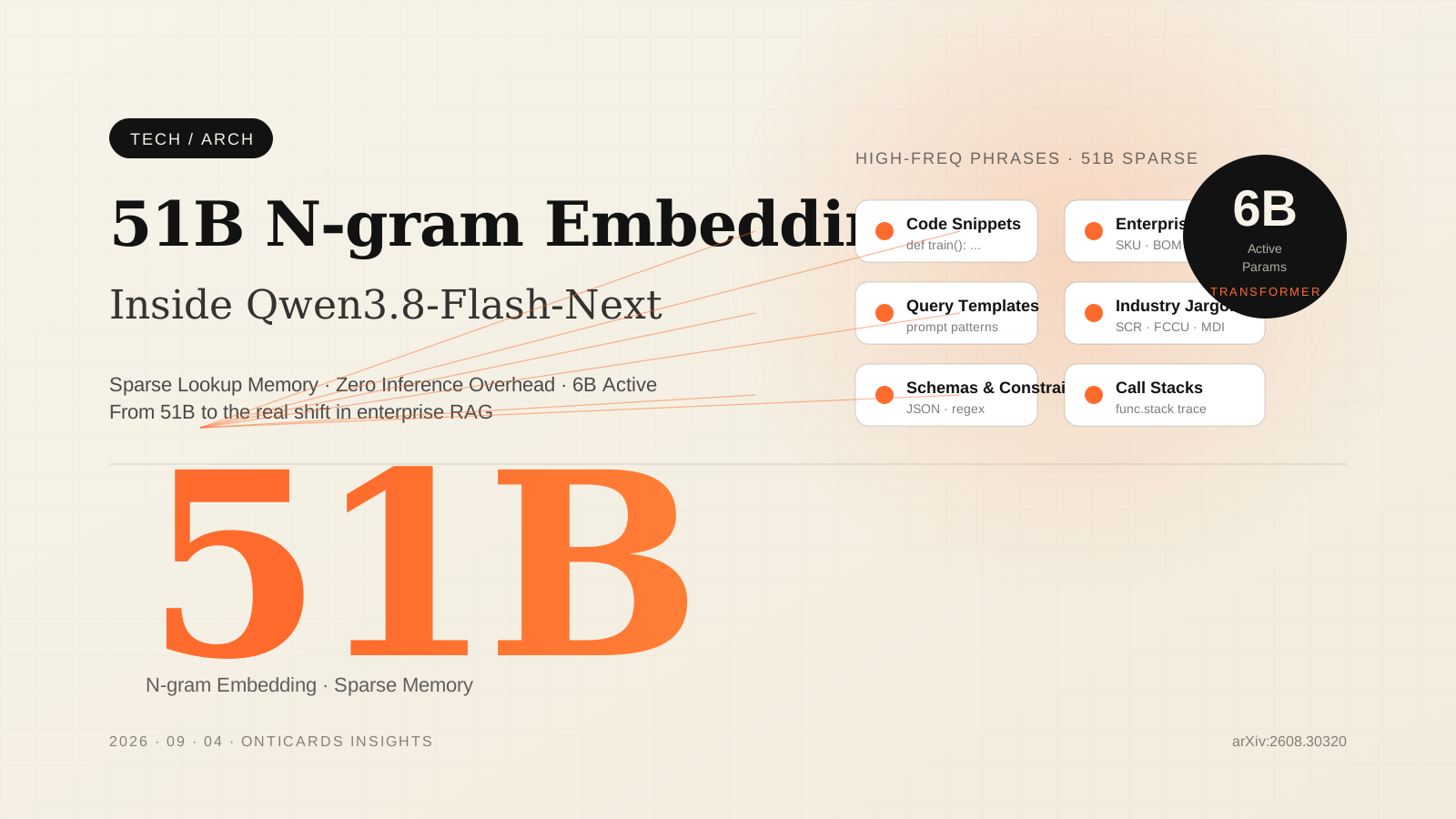
| N-gram Embedding | 51B | No (static lookup) | High-frequency phrase memory |
| Transformer backbone | 6B | Yes (real compute) | General language modeling |
The 51B is a stored vocabulary of N-gram phrase vectors, indexed and retrievable. The 6B is where the actual inference compute happens. This distinction is critical — most downstream confusion stems from collapsing the two.
1.2 How It Works
51B N-gram Embedding is not just a "bigger embedding table." It is a sparse lookup-based memory system. The lifecycle has three phases:
- Construction (pretraining): The model scans tens of TB of training corpora, automatically mines high-frequency N-gram phrases (industry terms, fixed collocations, proper nouns, code snippets), and freezes each one into an individual vector.
- Inference (every forward pass): After tokenization, the system performs a fast lookup against the 51B N-gram table (O(1) complexity); matched phrases are fed into the Transformer backbone as additional semantic anchors.
- Generation: The 6B backbone does not need to relearn the semantics of those high-frequency phrases — it inherits the table's representation, so its compute budget stays focused on generation logic and contextual reasoning.
1.3 Why It Matters
Against a dense baseline of similar size, 51B N-gram Embedding delivers three concrete gains:
- Zero inference overhead. 51B does not participate in compute. Single-token FLOPs drop roughly 60% versus a same-size dense model.
- Cold-start friendly. High-frequency phrases need not be learned from scratch — they are immediately effective in low-resource or vertical domains, materially reducing the "hallucination on small samples" failure mode.
- Interpretable by design. Every lookup hit is loggable. Developers can audit why the model used a specific expression at a specific point — a critical property for enterprise-grade deployment.
2. Three Misconceptions Worth Correcting
A lot of the public debate around 51B N-gram Embedding rests on three claims that don't survive an engineering read.
2.1 Misconception #1: It Is Built-In RAG
On a quick read, the words "lookup" and "external knowledge" sound like RAG folded into the weights. Mechanistically, though, the two are very different:
| Dimension | 51B N-gram Embedding | Traditional RAG |
|---|---|---|
| Knowledge storage location | Model weights (static embedding) | External vector store / document store |
| Retrieval timing | Single lookup before generation | Per-turn dynamic retrieval |
| Update mechanism | Retraining or fine-tuning required | Real-time append |
| Best fit | High-frequency phrases, fixed patterns | Long-tail knowledge, private-domain documents |
The former is "model-native memory." The latter is "external dynamic knowledge." They differ in granularity, refresh rate, and performance ceiling. Drawing a simple equivalence misses the point.
2.2 Misconception #2: RAG Will Disappear
If N-gram Embedding is this powerful, does RAG go away? No.
N-gram Embedding excels at high-frequency, deterministic, low-refresh knowledge — code snippets, enterprise product terms, regulatory phrasings, structured constraints. But enterprises carry a lot of knowledge that falls outside that:
- Long-tail and continuously updated: product manuals, regulatory documents, recent incidents.
- Unstructured semantics: contract clauses, post-mortem write-ups, conversation histories.
- Must-be-traceable: user-facing answers that need to point back to a specific source document.
For these workloads, external retrieval still beats static lookup on flexibility, freshness, and traceability. RAG isn't being retired — it is being pushed back into the role it should always have held: the dynamic, private-domain, refreshable layer of knowledge supplementation.
2.3 Misconception #3: A Leap in General Capability
51B + 6B sounds substantial. That does not translate to a step-change in general benchmarks. The reason is straightforward:
- Active parameters are still 6B — the metric that gates inference capability.
- A meaningful slice of the 51B is redundant phrase vectors with limited information entropy.
- General reasoning, math, and code performance are dominated by the Transformer backbone. N-gram tables are auxiliary memory, not cognitive upgrade.
Bench the model against a same-size dense baseline (e.g., Qwen3.5-7B) and the delta is typically a few percentile points — a marginal lift, not a leap across capability tiers. Treating this release as "the next flagship" is reading past the actual return on sparsity.
3. Our Read: Where LLMs and RAG Are Heading
Stepping back from the release hype, the longer-term signal in 51B N-gram Embedding is more interesting than the launch news.
3.1 LLMs Are Moving Toward "Fine-Grained Layering, Compute-Efficient Designs"
From DeepSeek MoE's expert routing, to Qwen3.8-Flash-Next's sparse N-gram Embedding, to the recent wave of "small-active + large-static" experiments across labs — the 2026 direction is unambiguous:
- Active parameters govern inference cost — drive it down.
- Static parameters govern knowledge capacity — drive it up.
- The two are decoupled, and combined on a per-workload basis.
This "layered" framing pushes model design and systems engineering onto the same blueprint, where trade-offs become explicit. It is not glamorous, but it is durable.
3.2 Lightweight RAG Will Fade. Enterprise RAG Will Upgrade.
In the short term, the "drop everything into a vector store and hope" flavor of lightweight RAG will progressively lose ground — its precision ceiling is too low, and capabilities like N-gram Embedding close that gap.
But Enterprise RAG will see a real upgrade:
- From "similarity recall + LLM generation" to multi-source fusion + permission governance + audit trail.
- From "one-shot retrieval" to conversational, multi-turn retrieval.
- From "document search" to structured + unstructured unified access (Text-to-SQL + Text-to-Doc).
51B in Qwen3.8-Flash-Next is not the end of RAG. It is, instead, the pressure that pushes RAG from "good enough" to "production trustworthy."
3.3 The Industry Will Retire Crude RAG and Move Toward Native Capability + Light Precision Retrieval
One direction worth highlighting: put what belongs in the model into the model; keep what must stay external, external.
- High-frequency phrases, terms, and templates → hand off to N-gram Embedding or similar mechanisms.
- Long-tail documents and dynamic content → hand off to RAG, but lighter, more precise, more explainable.
- Truly private or sensitive knowledge → hand off to on-prem knowledge graphs + strict permission boundaries.
This combination is, fundamentally, the engineering direction we see embodied in OntiCards — a dual-layer memory system, strict permission boundaries, and end-to-end auditability — so enterprises can capture the upside of large models without paying uncontrolled risk on every inference call.
4. Closing
To put the pieces together: 51B N-gram Embedding is not "built-in RAG," and it is not the silver bullet that retires RAG. It is a sparse-lookup memory system that uses static phrase vectors to lift recall on high-frequency knowledge, freeing the 6B backbone to focus on reasoning.
Its real value is on the engineering side — lower cost, higher interpretability, and natural fit for enterprise workloads — not on chasing a capability tier-break on general benchmarks. RAG will not vanish because of it; RAG will simply mature into a more precise, more governable enterprise form.
When the industry stops chasing "parameter FOMO" and "RAG FOMO," and starts asking seriously how to co-design models and systems, the next wave of AI value will actually arrive.
References
- Qwen Team. On the Design of Qwen3.8-Next Architecture: Evaluation, Efficiency, and Training Stability. arXiv:2608.30320, 2026. https://arxiv.org/abs/2608.30320
- Qwen Team. Qwen3.8-Flash-Next: A New Architecture, Towards Ultimate Cost-Efficiency. Qwen Blog, 2026. https://qwen.ai/blog?id=qwen3.8-flash-next
- Qwen Team. Qwen3.8-Flash-Next Technical Report. QwenLM/Qwen3.8-Flash-Next on GitHub, 2026. https://github.com/QwenLM/Qwen3.8-Flash-Next/blob/main/tech_report.pdf