How Policy Documents Become Data That LLMs Can Understand
A municipal talent service group's regional policy consulting platform structures and digitizes vast policy documents — precisely extracting issuing agencies, eligibility criteria, subsidy standards, and more — then uses hybrid retrieval and vector embedding so large language models can read and answer accurately, delivered through a WeChat mini-program and an offline exhibition hall.
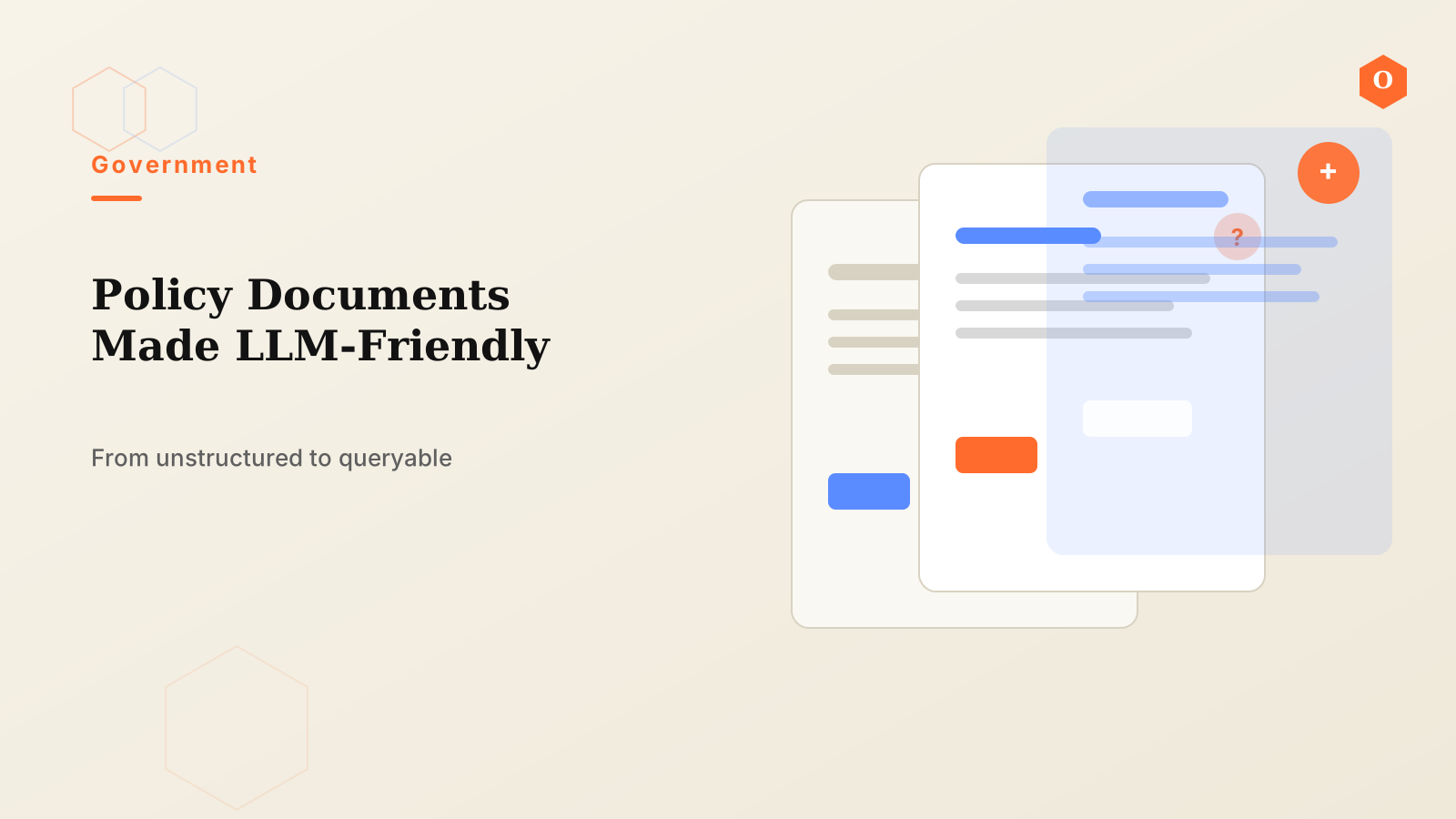
A municipal talent service group runs a regional policy consulting platform for talent programs. It faces a deceptively simple but genuinely hard problem: policy documents are overwhelming in volume, yet what citizens and businesses really need is "which policy do I qualify for, how much subsidy can I get, and how do I apply." Today, those answers are shifting from "people flipping through documents" to "LLM instant answers."
Background and Pain Points
Talent policies are naturally scattered across departments — human resources, science and technology, housing, taxation, and more. Each policy has its own publication channel, application window, and update rhythm. For ordinary users, policies are "hard to find, hard to understand, hard to use." The pressure on the consulting platform is just as severe: policy documents are massive, and extracting key elements has long depended on manual work. Staff must dig through long original texts to pull out issuing agencies, eligibility criteria, subsidy standards, application deadlines, and other elements, then relay them to inquirers. This is not only inefficient — it also makes consistent definitions difficult. The same policy can yield different answers at different consultation entrances.
The industry direction is already clear. The national-level Guidelines for Deploying AI Foundation Models in Government, issued by the Cyberspace Administration and the National Development and Reform Commission, calls on government departments to explore LLM applications in high-frequency scenarios such as intelligent Q&A, assisted handling, and direct policy benefits delivery. This means integrating business resources and knowledge bases, and using natural language understanding, retrieval-augmented generation (RAG), and knowledge graphs to provide convenient online consulting. The critical prerequisite: for an LLM to "understand" policies, the policy data must first be structured and standardized — exactly the problem this talent service group needed to solve.
What We Did
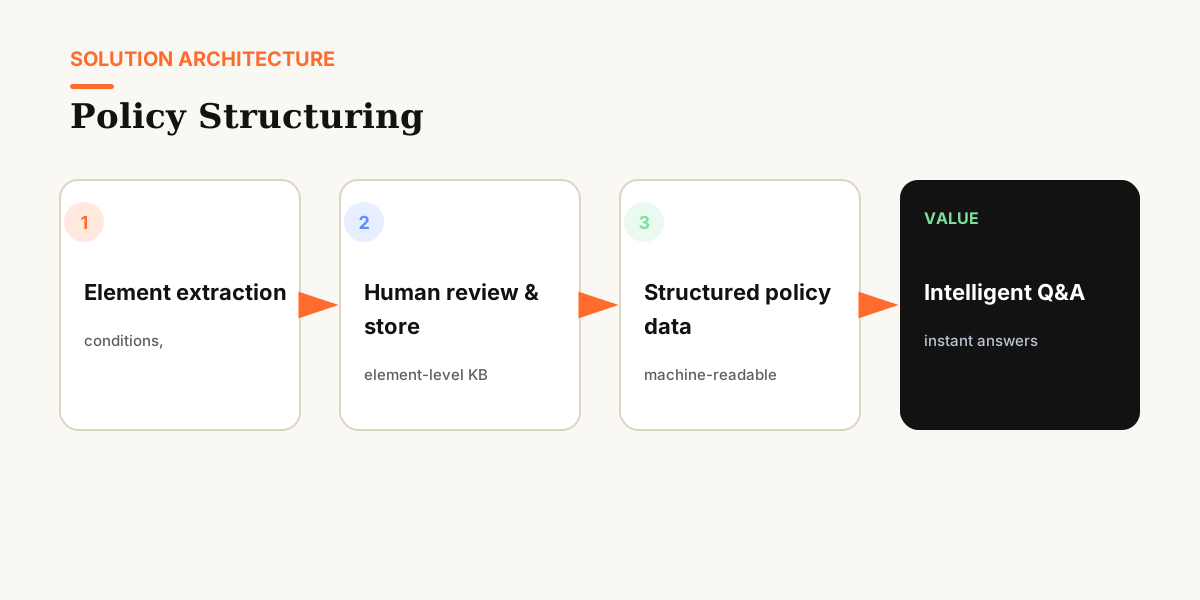
The core idea was to turn "policy documents written for people" into "policy data understood by machines," then build consulting services on top of that data. Three steps in total.
Step 1: Precise extraction of policy elements. Policy documents were processed structurally and digitally. An LLM automatically identified and extracted policy elements — issuing agency, eligibility criteria, subsidy standards, application deadlines, applicable groups, and so on. In the past, these elements were scattered across long texts and manually transcribed item by item; now models extract them in batches, and after human verification they enter a structured policy knowledge base.
Step 2: Standardization and vectorization. The extracted elements were organized under a unified specification so field definitions stay consistent and match what LLMs can understand. The data was then cleaned and embedded as vectors, transforming each policy into a vector in semantic space to lay the foundation for retrieval.
Step 3: Hybrid retrieval and multi-channel integration. The platform uses hybrid retrieval techniques and supports multiple retrieval modes — users can ask in natural language or narrow down with keywords and conditional filters, ensuring people with different habits can efficiently find what they need. The platform was ultimately integrated into a WeChat mini-program and an offline exhibition hall: citizens can ask questions anytime on their phones, and visitors at exhibition hall kiosks get immediate, accurate policy answers too.
Results
- Policy elements shifted from "manual transcription, item by item" to "model batch extraction plus human verification," significantly improving both efficiency and consistency.
- Policy definitions are unified within the platform — different entrances give consistent answers for the same policy.
- Online and offline channels both covered; consulting moved from "waiting for staff and flipping documents" to "instant answers."
- Consultants were freed from repetitive Q&A, focusing their energy on complex, difficult cases.
Lessons Learned: From the Project to OntiCards
This project proved one thing: the success of policy consulting applications depends not on model parameter count, but on whether the data has been shaped into something models can understand. Element extraction, definition alignment, vector embedding, hybrid retrieval — every step is data governance, not model tuning. Once policies become structured, semantically-rich data assets, the real power of LLMs is released.
These lessons have been distilled into OntiCards' solution for government and public services. Policy elements align naturally with our data cards philosophy: a card explicitly defines the fields, definitions, and relationships of a business object (such as "a policy"), and a query engine answers natural language questions on top of it. Scenarios like policy consulting, service guides, and application conditions are, at their core, "structured knowledge plus natural language Q&A" — precisely the kind of problem OntiCards is built to handle. Visit the OntiCards website to learn more.