Keeping Retiring Executives' Expertise in the Building with Decision Trees
Building a 'virtual executive' for senior managers approaching retirement, the platform uses a question-thought-chain-answer model and multi-path decision trees to turn each executive's decision process into an enterprise knowledge base that keeps serving management long after they leave.
At an international airport handling tens of millions of passengers a year, a generation of senior executives — people who invested the best two or three decades of their careers there — is now reaching retirement. Airport operations are far more complex than outsiders imagine: airside, landside, terminal, commercial, safety and emergency response, each domain built on a judgment system that only years of experience can establish. When these executives leave, the experience and decision-making ability in their heads goes offline with them. This project is about exactly that problem: keeping the brainpower in the building when the people walk out.
Background and pain points
Decision-making at airport management level is deeply experience-driven, and experience lives in specific people:
- Decisions are complex, and the context is tacit. Much of this judgment can't be written down as a rule. It's the hard-won "feel" from years of handling exceptional situations — when to authorize a release, when to pull the plug — and the reasoning behind it rarely fits into policy documents.
- Transfer is by word of mouth, and it has to wait. Successors need a long apprenticeship of shadowing executives, watching cases and listening to explanations before they build judgment. When the executive retires, that one-on-one channel is cut off.
- Knowledge has no structure. Executive experience sits scattered across meeting minutes, personal notes and memories — never forming a searchable, comparable, reusable organizational asset.
- Decision support is missing. Faced with a complex problem, management usually works from the information at hand and the judgment of the moment, with no reference to "how similar situations were thought through and decided before."
In one sentence: the organization's most valuable asset — executive judgment — is precisely the asset that has never been structured.
What we did
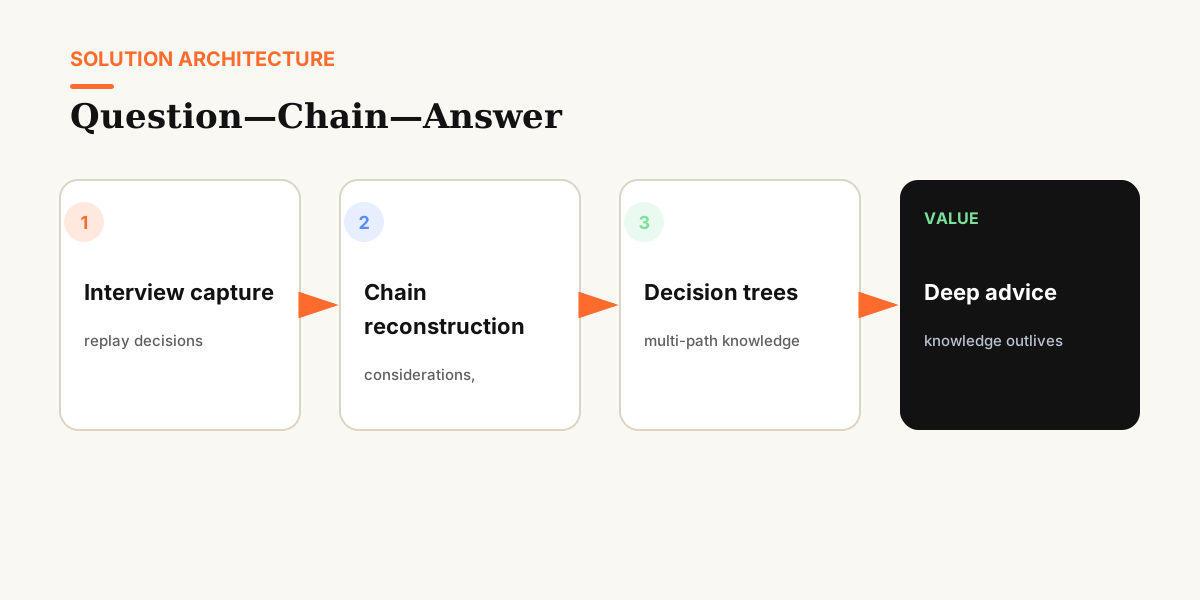
The core idea was to build a "virtual executive" for senior managers approaching retirement: using AI to preserve their hard-won experience and decision-making ability, so that it keeps supporting airport management long after the individual has retired.
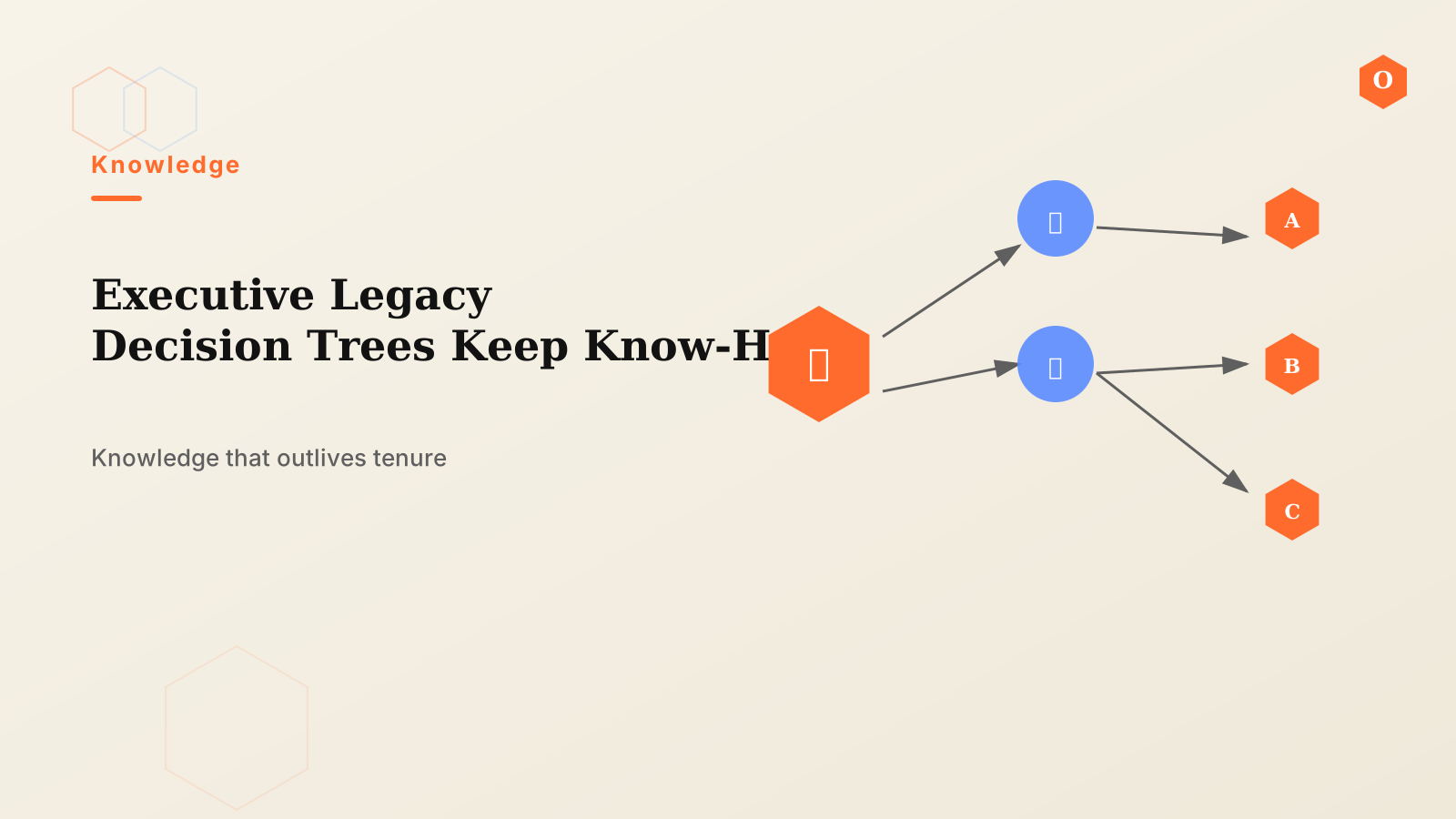
The platform works on a "question—thought chain—answer" model. An executive's decision process isn't recorded as a single conclusion; it's reconstructed as a complete chain of reasoning: what problem was faced, what considerations were weighed, which path was chosen under which conditions, and why the other options were ruled out. These thought chains are organized through multi-path decision trees — the same question can have several decision paths, each tied to different preconditions — and together they form an enterprise knowledge base.
On top of that knowledge base, the platform offers two capabilities:
- Deep advice. Management can raise a complex problem and the system traces the decision-tree path closest to the current situation, returning a recommendation grounded in the executive's reasoning — with the rationale attached, not just a blunt conclusion.
- Multi-dimensional comparison. How the same problem was handled by different executives, in different periods and under different resource constraints can be laid out side by side, so management sees "there are other ways of doing this" instead of being trapped in a single experience.
The platform also tailors its decision-support interface by role — operations, commercial, safety and emergency raise different questions, so the decision-tree entry points differ accordingly.
Results
The impact shows up on several levels:
- Transfer moves from "waiting" to "on demand." Successors no longer have to catch a busy executive between meetings. At any moment they can walk the decision tree to understand why their predecessor reasoned the way they did. Learning shifts from passive waiting to active retrieval.
- Decisions move from "gut feel" to "with a reference." Management gets advice that isn't an isolated conclusion but a frame of reference with the full reasoning trail attached, reducing the dependence of major decisions on one person's state of mind at one moment.
- An enterprise knowledge base goes from zero to one. The decision processes of multiple executives are now structurally captured, forming an asset that keeps accumulating — each new executive's experience grafts onto the same tree, and the knowledge base grows as the organization evolves.
The most visible change: retirement no longer means "capability reset." Before, when the person left, the experience left too. Now, the person retires, and the judgment keeps working from the knowledge base.
Lessons learned: from project to OntiCards
The deepest lesson from this project: to retain a person's judgment, you can't just record their conclusions — you have to record how they got there. The question—thought chain—answer structure is really a message to the organization: experience transfer has to be granular enough to capture the reasoning path, not just the final answer.
That experience directly shaped how OntiCards works. Thought chains and decision paths map to the explicit modeling of business objects and relationships in data cards — only when entities, fields, relationships and rules are structured first can AI do reliable reasoning and comparison on top. Multi-dimensional comparison maps to what the terminology bank and quality gates enforce — consistent definitions, traceable sources. And a knowledge base that grows with the organization maps to layered governance and continuous maintenance of data cards.
If your organization faces a wave of senior departures, keep one principle in mind: structure first, then make it intelligent. If experience can't first become a searchable, comparable asset, no model, however powerful, will hold on to it.