Managing Dispatch Knowledge Across Its Full Lifecycle: A Smarter Knowledge Platform for Airlines
Built around dispatch operations, the platform integrates existing structured knowledge with natural-language interaction and AI, covering the full lifecycle of knowledge — capture, management, application and evolution — across three business scenarios that turn manual handbook flipping into instant answers.
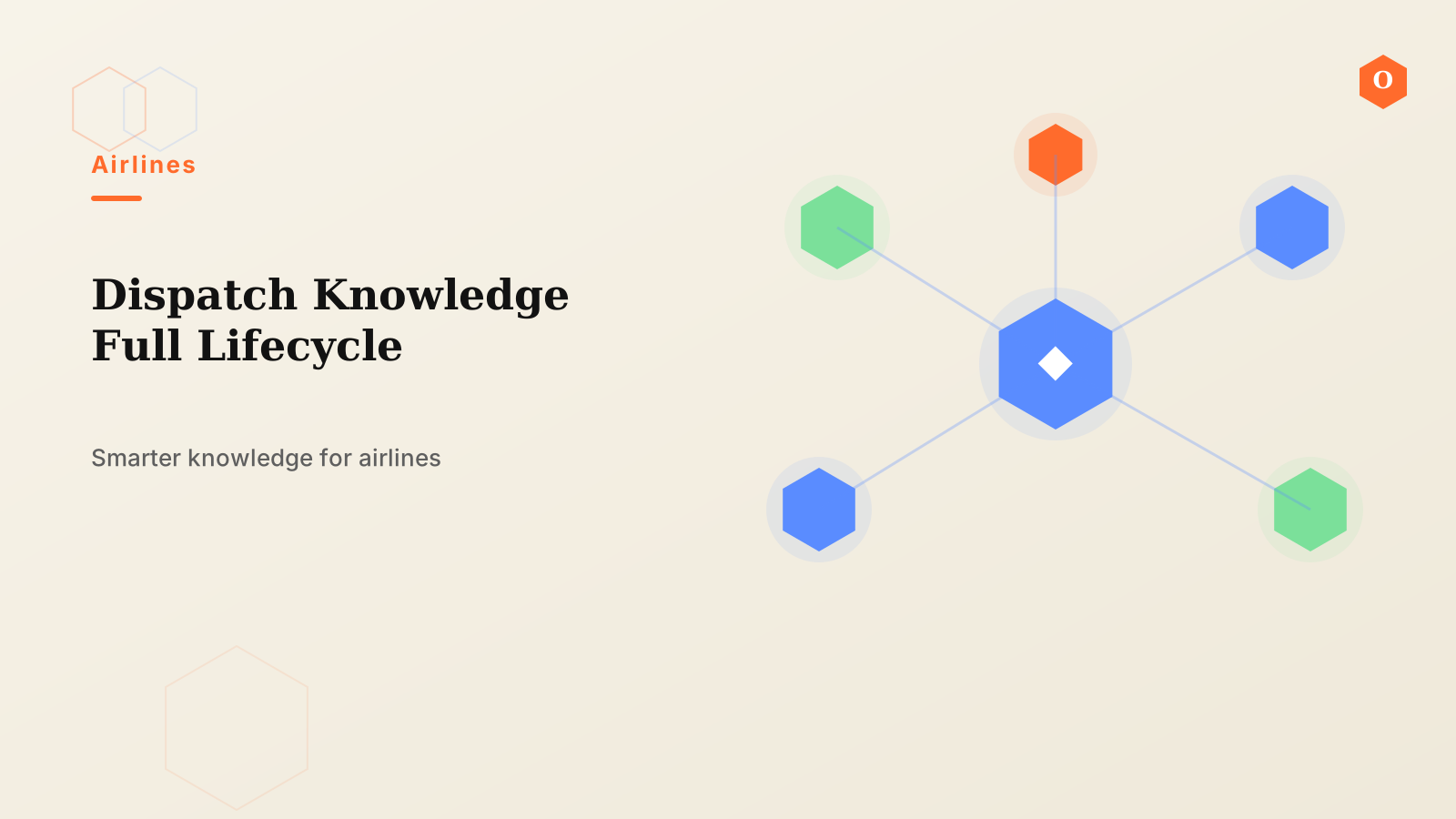
At the dispatch department of a nationwide airline, every flight decision — before takeoff and throughout the day — hinges on juggling weather, airport, crew, airworthiness and NOTAM information at once. In the past, that knowledge lived scattered across hundreds of operating manuals, constantly updated circulars and years of incident archives. Finding anything meant keyword matching; assembling an answer meant doing it in your head. Today, that department runs a knowledge platform built around dispatch operations, covering the full lifecycle of knowledge — capture, management, application and evolution — across three production scenarios.
Background and pain points
Dispatch sits at the nerve center of an airline's operations control, where every decision carries a tight time window and an enormous safety responsibility. The pain points here are typical of the industry:
- Knowledge is scattered and vast. Operating manuals, circulars and case archives live in different systems, in different formats, across many versions. Knowing where to look is already a barrier.
- Search is keyword-only. Traditional search is string matching. Ask "how do we choose an alternate airport in heavy fog" and you get back documents that merely contain the word "alternate" — you still have to find the actual clause yourself.
- Experience lives in people's heads. The judgment that senior dispatchers and inspectors have built over years — how they interpret clauses, how they handle edge cases, how they review incidents — is mostly passed on by word of mouth. When someone transfers or retires, tacit knowledge walks out the door.
- Knowledge goes stale. Manuals and circulars change constantly; a legacy search system gives no guarantee that what you retrieve is the latest version.
In one sentence: the knowledge is there. What's missing is a mechanism that lets it be retrieved accurately and in time, exactly when it's needed.
What we did
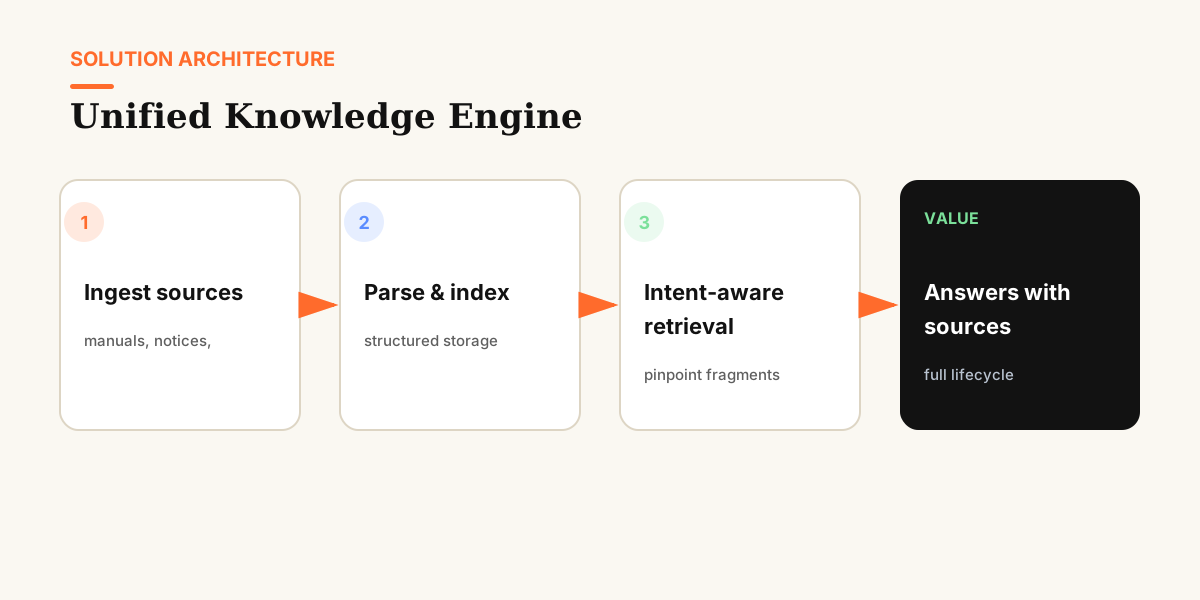
The project team never set out to "build a better search box." The brief was a unified platform covering the full knowledge lifecycle — where knowledge comes from, how it's managed, how it's applied, and how it keeps evolving — with all four stages wired together.
The platform follows a "core engine + business scenarios" modular design. The core engine at the bottom handles ingestion, parsing, indexing and updating. Business scenarios plug in on top, and three went live first.
Scenario 1: Intelligent retrieval and Q&A. Instead of simple keyword matching, the platform understands question intent, pinpoints the relevant knowledge fragments across manuals, circulars and the case archive, and returns a structured answer summary — with the source still traceable. A dispatcher asks a question in plain language and gets an answer with citations, not a list of documents to dig through.
Scenario 2: Scenario simulation and decision rehearsal. The platform supports simulated scenarios built from real historical data or preset conditions. Dispatchers can rehearse responses to severe weather, large-scale delays and diversion planning without taking real operational risk — training the playbook before the event, not after.
Scenario 3: Structured knowledge co-creation and sharing. The platform gives senior dispatchers and inspectors tools to turn their experience, interpretations and post-incident reviews into structured knowledge, which enters the repository only after review. Tacit knowledge becomes explicit; personal experience becomes team assets — and then gets reused over and over through scenarios one and two. Knowledge enters a virtuous loop where the more it's used, the better it gets.
Results
The impact of the platform comes down to three shifts:
- From flipping manuals to instant answers. With intelligent retrieval and Q&A, dispatchers handling irregular operations no longer page through printed handbooks. Retrieval dropped from a minute-level hunt to an instant, conversational response, with multi-source information aggregated in a single view.
- From one-off queries to a full lifecycle loop. Capture, management, application and evolution now run as one closed loop on a single platform. Knowledge updates propagate quickly into frontline Q&A and simulation scenarios, sharply reducing the systemic risk of outdated versions and obsolete clauses.
- From privately held experience to organizational knowledge. With all three scenarios combined, senior judgment can be recorded, searched and rehearsed. New dispatchers' learning curves get visibly steeper — training moves from "shadow a mentor" to "practice with a purpose."
What these shifts share is that knowledge gets structured for capture and intent-driven for retrieval — which is exactly the first lesson any data-driven organization has to learn on the road to intelligence.
Lessons learned: from project to OntiCards
The most important takeaway from this project: a knowledge system stands or falls on whether the knowledge itself is governed in a structured way — not on the model. The model's job is to understand the question and compose an answer. But the rules — which manuals are current, which clauses are retired, what a concept is called in different departments, which knowledge needs review before it can go public — have to be made explicit first.
That experience directly shaped how OntiCards works. The knowledge ingestion layer maps to data cards: entities and business fields — not physical database columns — become the basis for Q&A. The terminology bank handles the "many names for the same thing" problem with a single mapping layer. Quality gates mirror the review and versioning workflow, so content that fails the bar never enters the knowledge base.
If you're building an enterprise knowledge platform, ask yourself three questions first: Is there a unified business definition for the knowledge? Is there a review loop for updates? Can every answer be traced back to its source? Get three "yeses" — then talk about large language models.