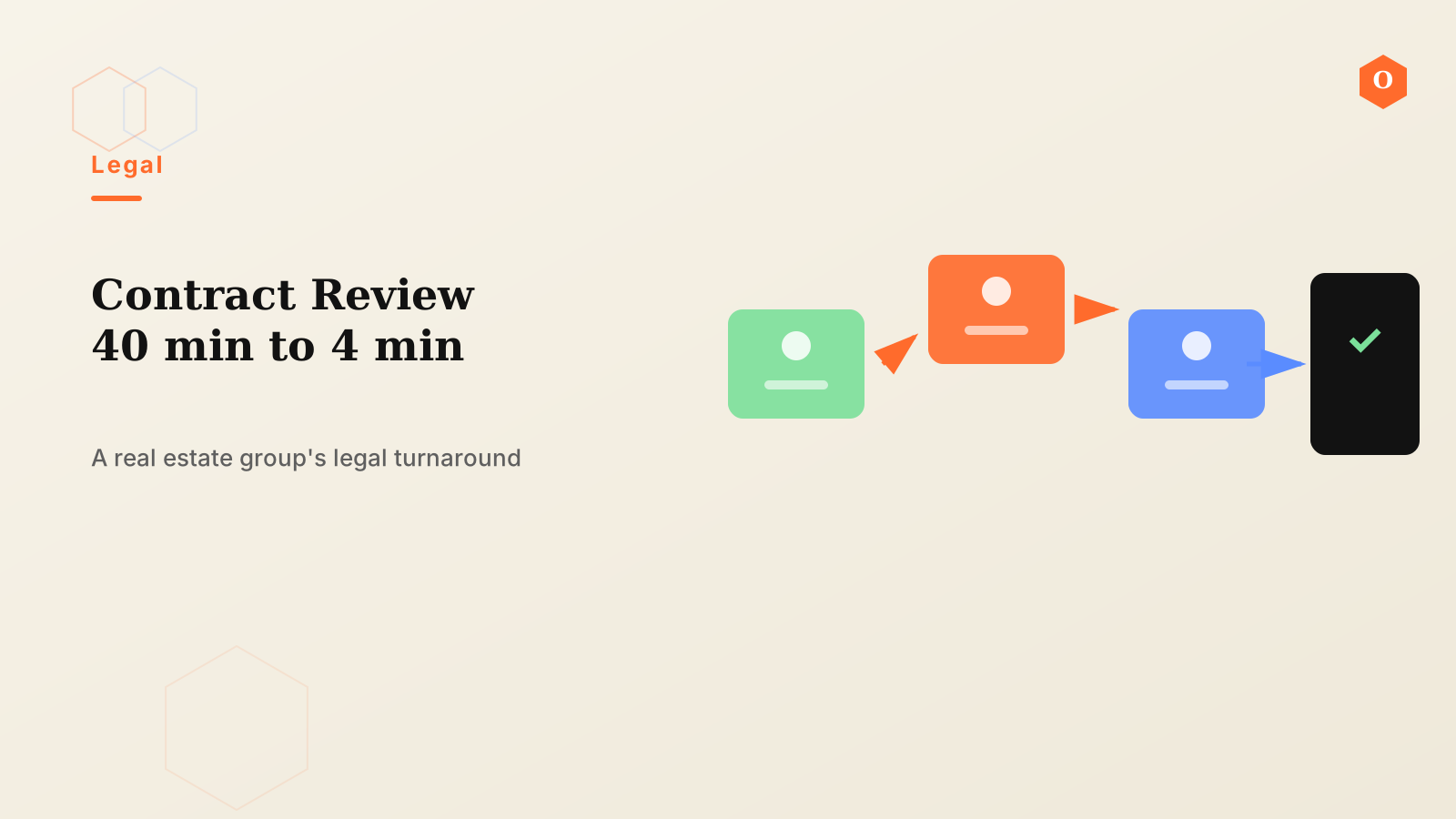
Contract Review from 40 Minutes to 4 Minutes: A Real Estate Group's Intelligent Legal Turnaround
NLP + large language models + an expert rule base: automatically identifying key clauses, potential risks, and compliance points, with structured comparison, smart annotations, and risk grading. A real estate group spanning residential, commercial, and industrial parks moved its legal work from 'manual checking' to 'intelligent decision support.'
The "First-Pass Review" in the Legal Office
A national real estate and urban operations group, spanning residential, commercial, and industrial parks, has a legal team that processes thousands of contracts every year. In the past, reviewing a routine contract meant reading it line by line by hand — whether a clause carried risk, whether a compliance point was missed, and how it differed from the group's standard template all depended on the experience and patience of senior legal staff.
Today, that work has an "AI first pass": the system automatically identifies key clauses, potential risks, and compliance points in contracts, producing structured comparisons, smart annotations, and risk-graded alerts. Reviewing a routine contract has gone from dozens of minutes of manual reading to AI-first-pass review in seconds plus a few minutes of human verification — shifting legal professionals' energy from "reading every word" to "judging what matters."
Background and Pain Points
Real estate groups are classic contract-intensive organizations: enormous volumes of contracts with suppliers, contractors, and agencies, whose clause types are highly similar yet individually different. Traditional contract review long relied on manual effort, and three problems stood out.
First, low efficiency. A contract of dozens of pages required dozens of minutes of manual reading and comparison, and bulk procurement or engineering contracts took even longer. With high contract volume and limited headcount, review scheduling often became a bottleneck for business progress.
Second, inconsistent standards. For the same type of clause, different legal professionals understood and calibrated things differently — review outcomes depended on individual experience. The group lacked unified review standards and definitions, so quality varied.
Third, risk omissions. Manual, page-by-page reading is tiring, and key clauses or hidden risks could slip through. Especially in high-risk clauses involving payment, breach, IP, and confidentiality, a single omission could mean real losses.
These problems are universal across the legal industry. Contract review is considered one of the most time-consuming and costly parts of legal work — a huge amount of professional effort is spent "finding clauses" rather than "assessing clauses."
What We Did
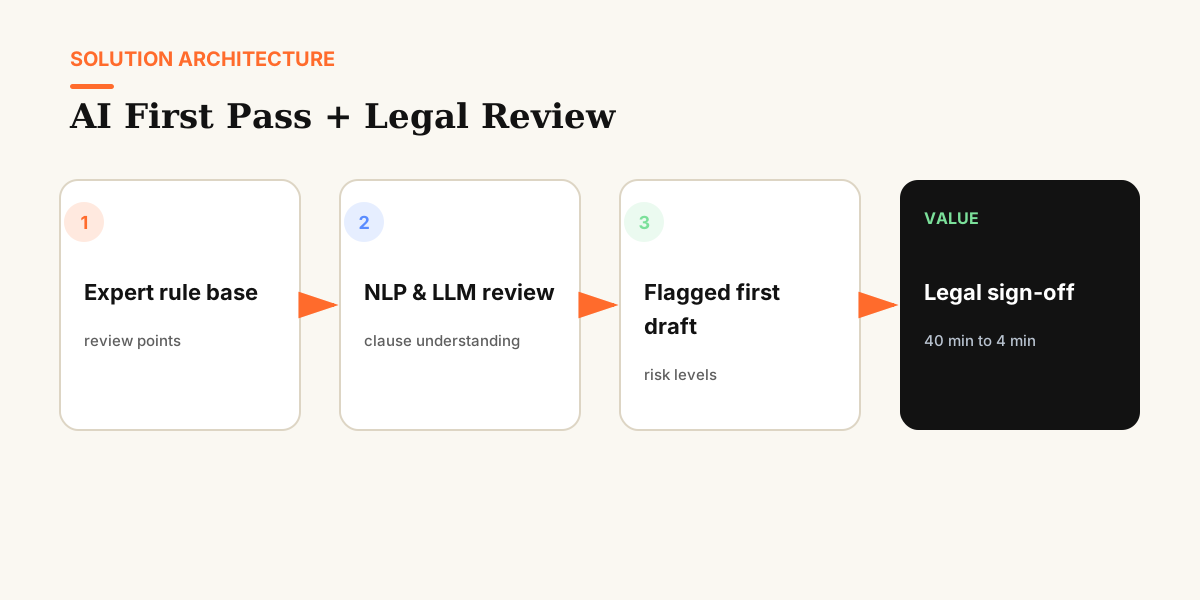
The project adopted "AI first-pass review + lawyer verification" as its core working model, built on a combination of natural language processing (NLP), large language models, and an expert rule base.
First, an expert rule base defined "what to review." Together with the group's legal team, we codified the review points for high-frequency contract types — payment terms, breach liability, IP ownership, confidentiality clauses, dispute resolution — into structured rules. The rule base is the business's "standard answer," keeping the review criteria consistent with group requirements and eliminating "inconsistent standards."
Second, NLP and large language models handled "how to review." The system parses contracts automatically: identifying clause structures and extracting key elements, then combining the LLM with the expert rule base to judge potential risks and compliance points item by item. Each contract receives a structured review output — risky clauses highlighted, annotations explaining why, and risk levels graded.
Third, "structured comparison + smart annotations" supported verification. The contract under review is compared structurally against the group's standard templates and historical contracts of the same type, making differences immediately visible. AI-generated annotations point directly to the source text, so lawyers only review the highlights instead of rereading the whole document. The entire process is retained and traceable, with a clear, auditable path for how risks were found.
On the engineering side, the project followed the principle of "start small, start with templates": first running the "AI draft review + human verification" loop on high-frequency contract types such as procurement and sales, validating accuracy and acceptance, then expanding to other contract types. For clauses the model was not confident about, the rule base and human review served as a double safety net — better to over-flag than to miss.
Results
- First-pass review accelerated: reviewing a routine contract went from dozens of minutes of manual reading to AI review in seconds plus minutes of human verification — an order-of-magnitude efficiency gain.
- Unified review standards: the expert rule base gives "how to review and what to review" a solid foundation; review criteria are consistent group-wide, no longer dependent on individual experience.
- Fewer risk omissions: key clauses, potential risks, and compliance points are scanned item by item; high-risk clauses are graded and flagged, with human verification focused on the essentials.
- Elevated legal roles: legal work moved from "manual checking" to "intelligent decision support," freeing professional capacity for higher-value work like negotiation strategy and deal structuring.
- Traceable process: annotations point to the original text and review history is retained, satisfying internal audit and compliance requirements.
Lessons Learned: From Project to OntiCards
This project distilled three reusable methodologies. First, build the rule base first: the quality ceiling of AI review is set by business rules — codify the "review standard" with the legal team before talking about model capabilities. Second, let humans and machines play their own roles: AI handles full-coverage scanning and initial screening, lawyers handle key judgments and final sign-off — neither replaces the other. Third, grade instead of one-size-fits-all: risk grading lets lawyers prioritize, improving both review efficiency and review quality.
These lessons became OntiCards' solution capability for real estate and legal tech — combining "structuring business rules" with "scaling AI processing" is the common backbone of this class of intelligent projects. For the broader question of turning domain knowledge into AI-ready assets, see OntiCards' four-layer architecture and our knowledge readiness practice.