Data Agents Have Their Own Market Now — 3 Signals from IDC
On September 1, IDC published its first China Data Agent vendor assessment: 18 vendors entered, only four reached the Leaders quadrant, and the firm forecasts that 60% of China's top 500 enterprises will deploy enterprise-grade data agents by 2028. Data agents have officially become their own procurement category. Here are the three signals that matter and the four foundations to lay before going live.
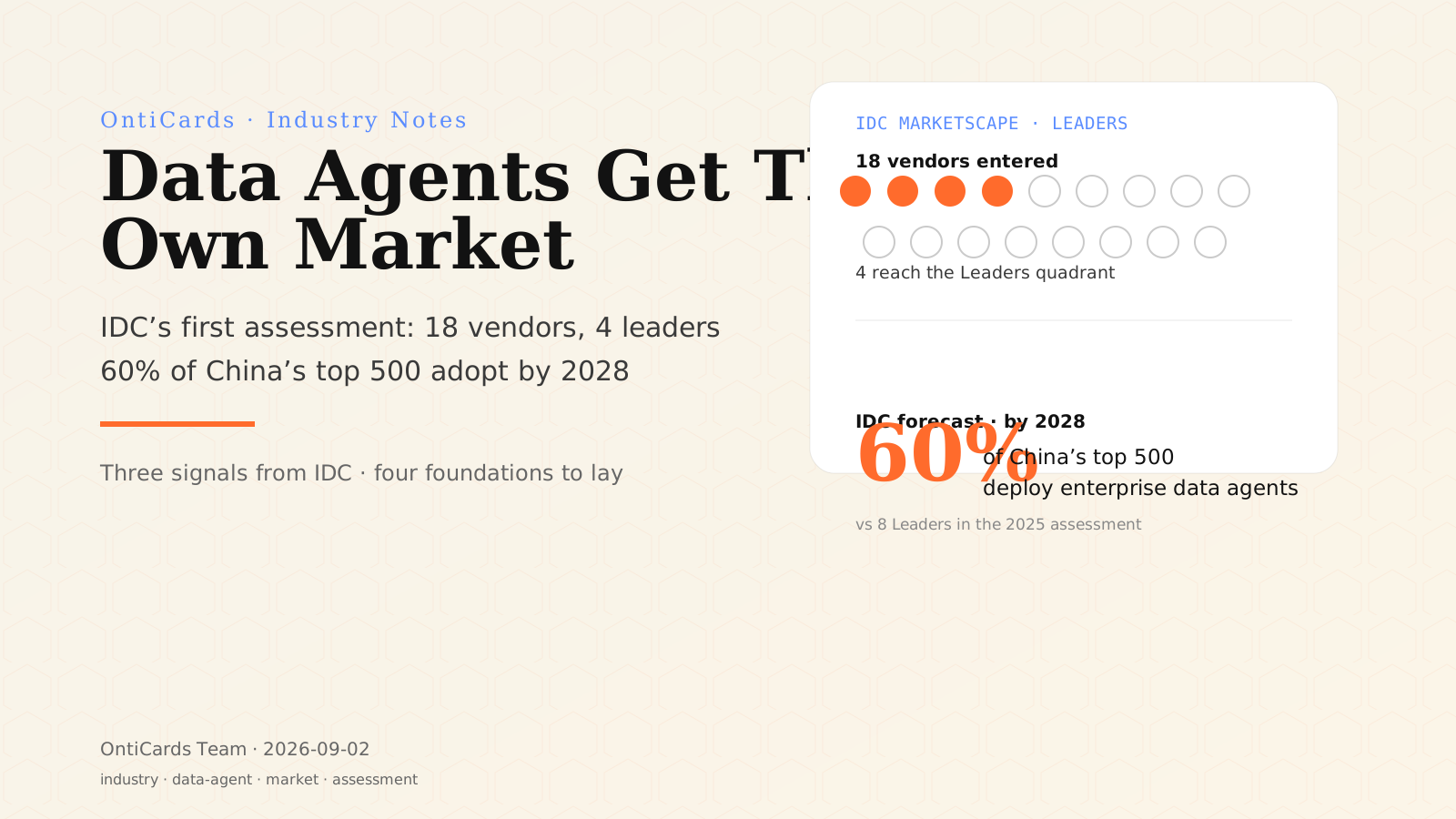
On September 1, IDC published the IDC MarketScape: China Data Agent 2026 Vendor Assessment — the first time data agents have been ranked as their own product category. Eighteen vendors made the cut; only four reached the Leaders quadrant. Tucked into the same document is an even more consequential forecast: by 2028, 60% of China's top 500 enterprises will deploy enterprise-grade data agents.
Our read is straightforward: this category has moved past the "should we use it?" debate and into the "what criteria should we buy on?" phase. The real dividing line is not the model. It is whether the data side of your organization can hold an agent up.
1. A definition first: a Data Agent is not rebranded ChatBI
IDC's definition is worth quoting in full: a Data Agent is "a new-generation data intelligence paradigm that uses AI agent technology to connect data integration, governance, analysis, and business decisions into an automated closed loop" — an industry shift from "data supporting AI" to "AI managing data autonomously."
Unpacked: BI is a window for people to read reports. Text-to-SQL turns "writing SQL" into a conversation. A Data Agent hands the entire pipeline — fetch data, validate it, diagnose it, recommend an action — to a system that runs it end to end, with every step inspectable and auditable. The gap between that and a one-off query tool is exactly what we wrote about last week: Text-to-SQL accuracy collapses to 25% inside real enterprises. The bottleneck was never "can it generate SQL," but "after it generates SQL, why should anyone trust it?" By giving data agents their own vendor assessment, the industry has effectively promoted business semantics, data quality, and access boundaries from back-office concerns to front-line acceptance criteria.
This connects to what we have argued for weeks: agent adoption is decided by data readiness first, and by isolation and governance once agents run at scale. A data agent is just those two arguments, converged on the specific job called "data."
2. Three signals from IDC's first assessment
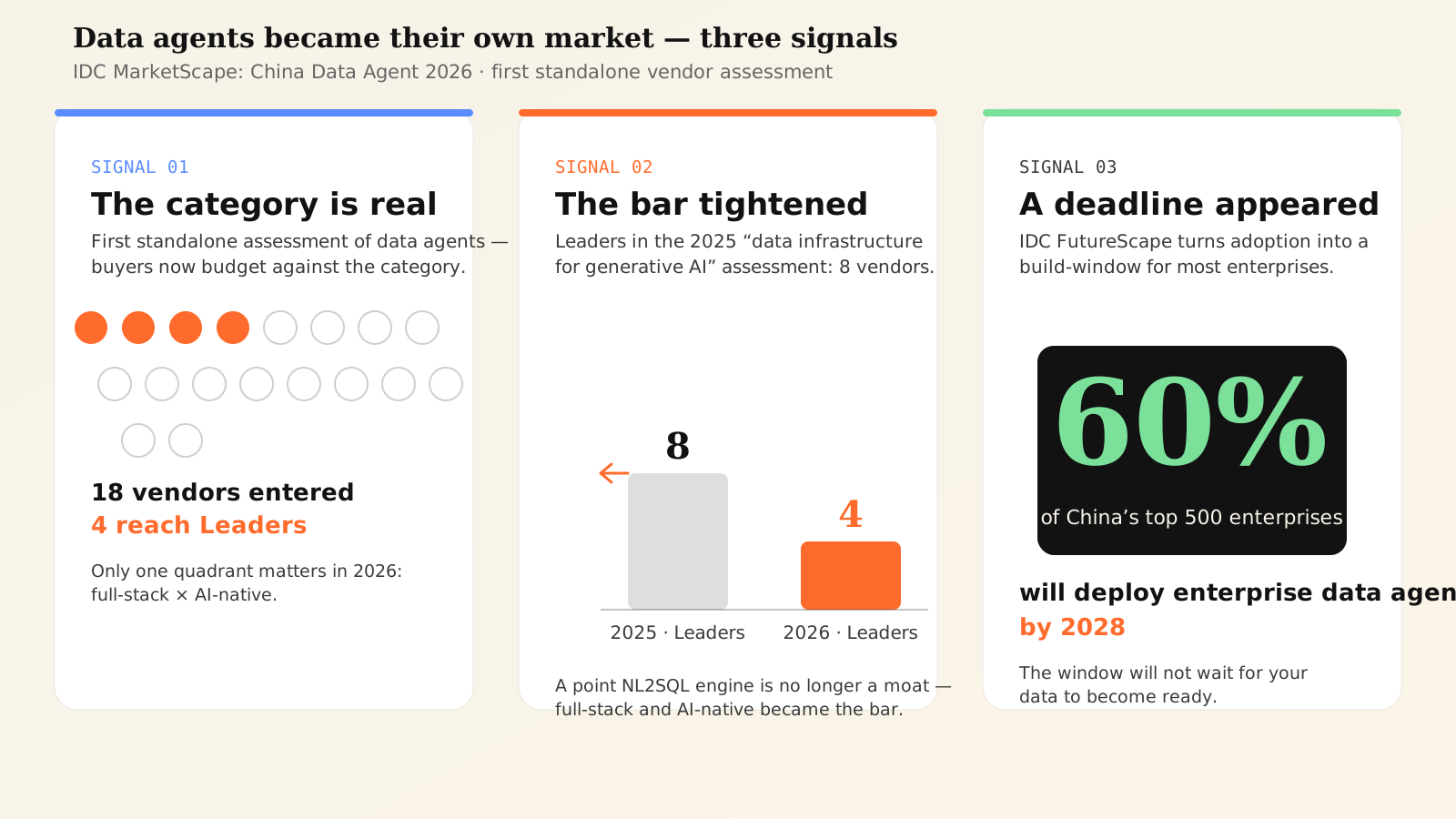
Signal one: the category is real. This is the first time data agents have been assessed as a standalone market by a third-party analyst. Enough vendors exist to require a quadrant, and buyers are already budgeting against the category — otherwise the report would not exist.
Signal two: the bar is getting higher. In the 2025 assessment of "data infrastructure for generative AI," eight vendors made the Leaders quadrant. This time, only four out of 18 did. IDC attributes the shift to full-stack capability and AI-native architecture becoming the new competitive watershed. In plain terms: a point model or a point NL2SQL engine is no longer a moat. Only platforms that connect the whole chain — from data integration to business decisions — survive the cut.
Signal three: the timeline is now explicit. IDC forecasts that by 2028, 60% of China's top 500 enterprises will deploy enterprise-grade data agents. For most organizations, that makes the next two years the build window — and the window will not pause while your data gets ready.
One more detail worth noting: Alibaba Cloud sits in the most advanced position within the Leaders quadrant. Its DataWorks Data Agent splits the job into four agent roles — data development, data governance, data analysis, and engine operations — backed by expert packs and a skill library, while its AIDBS service claims support for 100+ multimodal and multi-cloud data sources. The interesting part is not "who is first." It is why: not a single model, but years of accumulated data engineering across the full stack. That is signal two, demonstrated.
3. Two playbooks emerging: platform suites and agent families
Signals tell you a market is forming; products tell you how it will actually ship. Two other announcements this week show the two dominant playbooks.
Playbook A — platform vendors package data agents as out-of-the-box suites. Alibaba Cloud shared two numbers: after joining AIDBS, tea-chain Gu Ming cut the lead time for self-service analytics requests from days to 2–4 hours; Cainiao built a SuperETL skill system on DataWorks, packaging senior engineers' expertise into composable skills and lifting development efficiency 10×. The value proposition of the platform route is speed — data requests that used to queue for weeks now land in hours.
Playbook B — industry players deploy agents as a family of roles. Also on September 1, Cheche Group (NASDAQ: CCG) launched its ABAO Agent Family: five specialized agents spanning the full new-energy-vehicle (NEV) insurance value chain. A claims-companion agent for vehicle owners covers first notice of loss, damage assessment, and status tracking — live with Volkswagen Anhui and Avatr, and integrated with PICC, Ping An, and China Pacific Insurance. An underwriting and pricing agent lets carrier professionals query millisecond-level multi-dimensional risk analysis in natural language by entering a license plate or VIN, powered by a pricing model with 200+ dynamic risk factors. Three more agents run internally, handling customer-service quality control, cross-department settlement follow-up, and — the hard one — non-standardized settlement documents. Results: settlement workflow efficiency up 30%, overall settlement processing efficiency up 50%, with no additional headcount.
Cheche's case is more instructive than most demo videos. It did not build one all-powerful agent; it decomposed work by role into a family of agents that collaborate. And those agents only run because every document type, every risk factor, and every underwriting rule was first structured into data assets the agents could call — including the messiest, most inconsistent settlement documents. In other words: the number of agents does not matter. The layer of data under the agents does.
One more signal along the same lines: legacy enterprise-software vendors are taking the same course. Donghua Software's enterprise AI data portal, launched on August 28, names "semantic layer + ontology + Text2SQL engine" as its three core capabilities. When system integrators start describing architecture with the same vocabulary, that architecture has become the category default.
4. Before you pick a platform, lay four foundations
Once a category forms, the most common mistake is spending the whole budget on "which platform" while forgetting that a data agent only produces value if your data has been governed well enough to be understood correctly. Drawing on IDC's evaluation dimensions and our own implementation experience, four foundations should be laid before any tool selection:
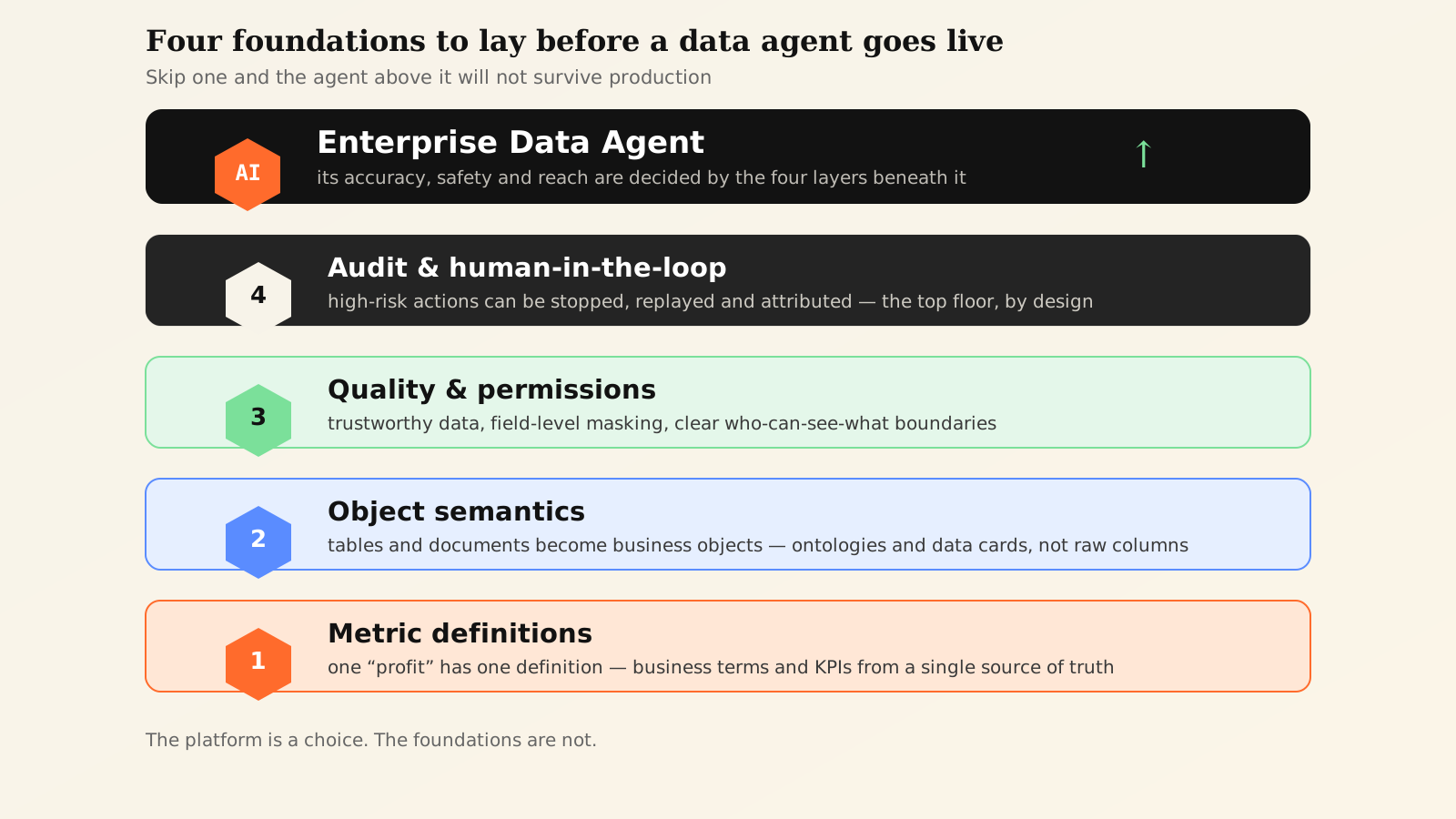
| Foundation | What it solves | If you skip it |
|---|---|---|
| Metric definitions | One "profit" has exactly one definition; metrics and business terms have a single source of truth | Ten agents report ten different profits |
| Object semantics | Tables and documents become business objects (ontologies, data cards), not raw columns | Agents guess joins against bare tables; Q&A is a lottery |
| Quality and permissions | Data is trustworthy, fields are masked, and who-can-see-what is explicit | Agents confidently feed wrong numbers — or reach beyond their authority |
| Audit and human-in-the-loop | High-risk actions can be stopped, replayed, and attributed | When something breaks, no one can say which step, person, or agent did it |
These four foundations map directly onto how OntiCards is built: business glossaries and ontology modeling handle metrics and objects; data cards attach semantics and permissions to every data asset; data quality checks and an organization-wide security and permission system handle trust and boundaries; and end-to-end audit trails with mandatory approval on high-risk operations make human-in-the-loop the default. The full design is documented in our four-layer architecture, and you can walk through the product from our product page.
Closing
The most important thing about data agents entering IDC's quadrant is not who ranks first. It is that the yardstick changed: every vendor that reached the Leaders quadrant first solved the problem of "how does AI understand data correctly." The same logic applies inside your organization — you can postpone the model budget, but you cannot postpone the data foundation.
Want to try the full chain — ontology modeling → data cards → natural-language querying — in a sandbox environment? Email hello@onticards.com and we will have an FDE engineer run one real scenario with you.
References
- Alibaba Cloud tops IDC China Data Agent assessment: only 4 of 18 vendors reach Leaders (登頂!阿里雲拿下 IDC 中國 Data Agent 頭名:18 家僅 4 家入選), Kuai Technology via Sina Finance, 2026-09-01. https://finance.sina.cn/tech/2026-09-01/detail-iniqhwmv6654127.d.html
- Alibaba Cloud named Leader in IDC China Data Agent assessment (阿里雲登頂 IDC 中國 Data Agent 領導者), Global Times Tech via NetEase, 2026-09-01. https://www.163.com/dy/article/L5OLF2BG0514R9OJ.html
- Cheche Group Launches ABAO Agent Family, Deploying AI Across the Full NEV Insurance Value Chain, Cheche Group Inc. press release (SEC EDGAR filing), 2026-09-01. https://www.sec.gov/Archives/edgar/data/1965473/000149315226040944/ex99-1.htm
- Donghua Software releases enterprise AI data platform to solve data-feeding challenges, Sina Finance, 2026-09-02. https://finance.sina.com.cn/wm/2026-09-02/doc-iniqkqvk3169890.shtml