A Regional Top-Tier City Commercial Bank Turns Institution-Wide Knowledge into One Question, One Answer
26 departments surveyed, 8 business-specific agents, dual-dimension tags and multi-channel permission routing — a regional top-tier city commercial bank with RMB 600 billion in assets consolidated scattered institutional knowledge into one entry point where employees get answers in seconds.
One Bank, One Answer for Every Question
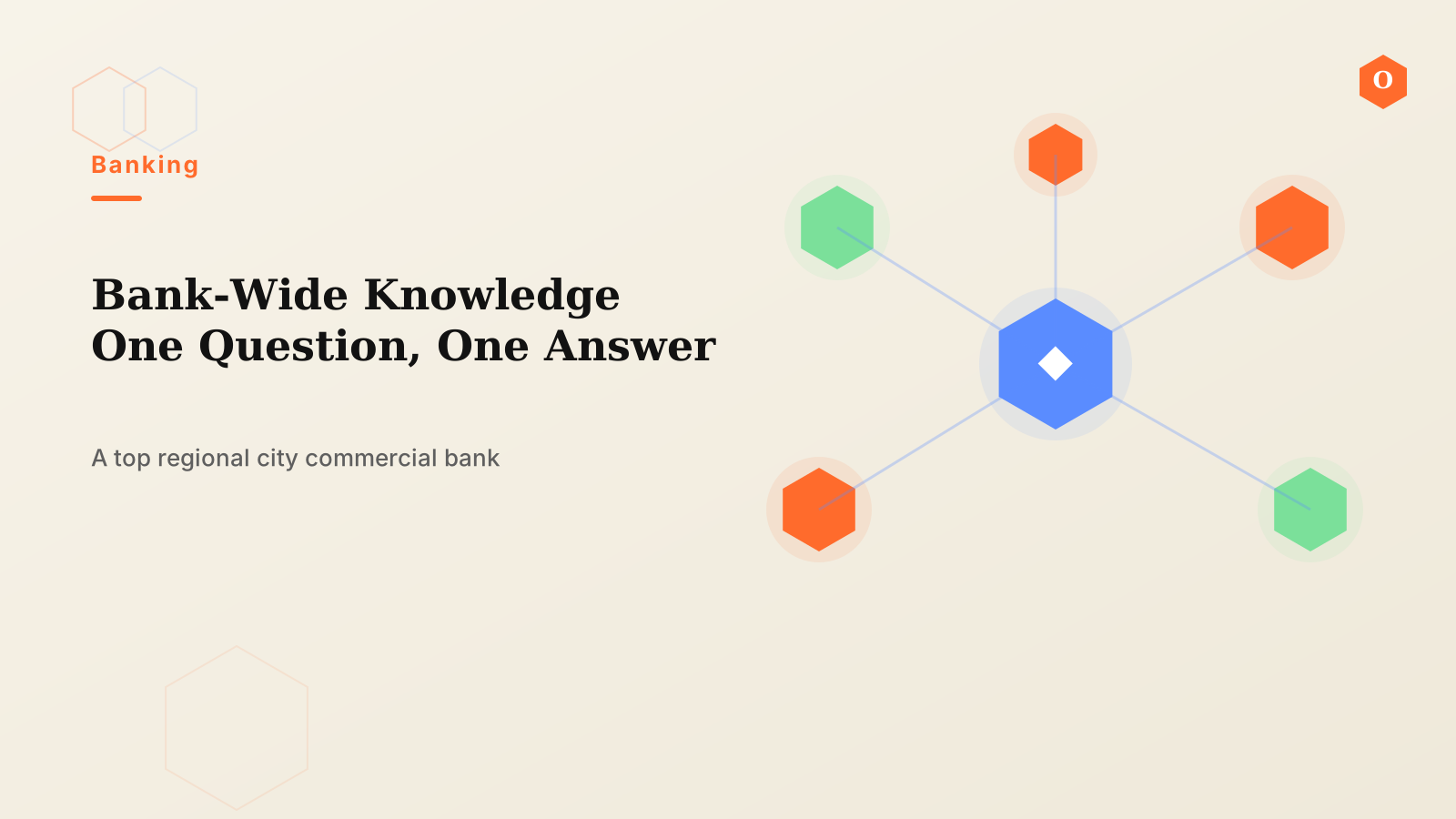
A regional top-tier city commercial bank with RMB 600 billion in assets has packed the institution's policies and knowledge into a single conversational entry point. Previously, when an employee was processing a transaction or following a procedure, checking the latest policy meant digging through several systems and asking several different people. Today, employees simply ask in natural language and receive an accurate policy interpretation or operating guide within seconds — with the original source traceable.
The project began with in-depth surveys of 26 departments, built 8 business-specific agents, and ended with an institution-wide knowledge platform built on "one entry point plus multi-agent collaboration" — bringing the knowledge dormant in thousands of documents into everyday, ask-and-answer capability.
Background and Pain Points
Like most peers, this bank had long struggled with fragmented knowledge management. Institutional policies and documents were scattered across independent systems, forming "knowledge silos": repetitive inquiries drained expert capacity, cross-department collaboration was inefficient, and cross-functional search was slow and difficult. The bank had accumulated thousands of high-value documents, but their utilization was extremely low — unstructured formats made traditional search unreliable.
The deeper contradiction lay in the lack of systematic capability. Existing knowledge could not be standardized for external delivery, making "build once, reuse bank-wide" impossible, and the AI technology foundation was thin. Documents containing complex tables and scanned pages were slow and error-prone to process manually, with no automated extraction or precise ingestion. Meanwhile, AI use cases proliferated without platform-level orchestration, risking redundant knowledge bases. What was needed was a unified platform for development, orchestration, and iterative knowledge management that would keep AI assets secure and compliant.
These pain points are becoming increasingly common across financial services. As large language models mature, more and more banks are making knowledge management the main battleground for AI adoption — from policy Q&A to compliance interpretation, knowledge-centric scenarios touch the daily work of nearly every role.
What We Did
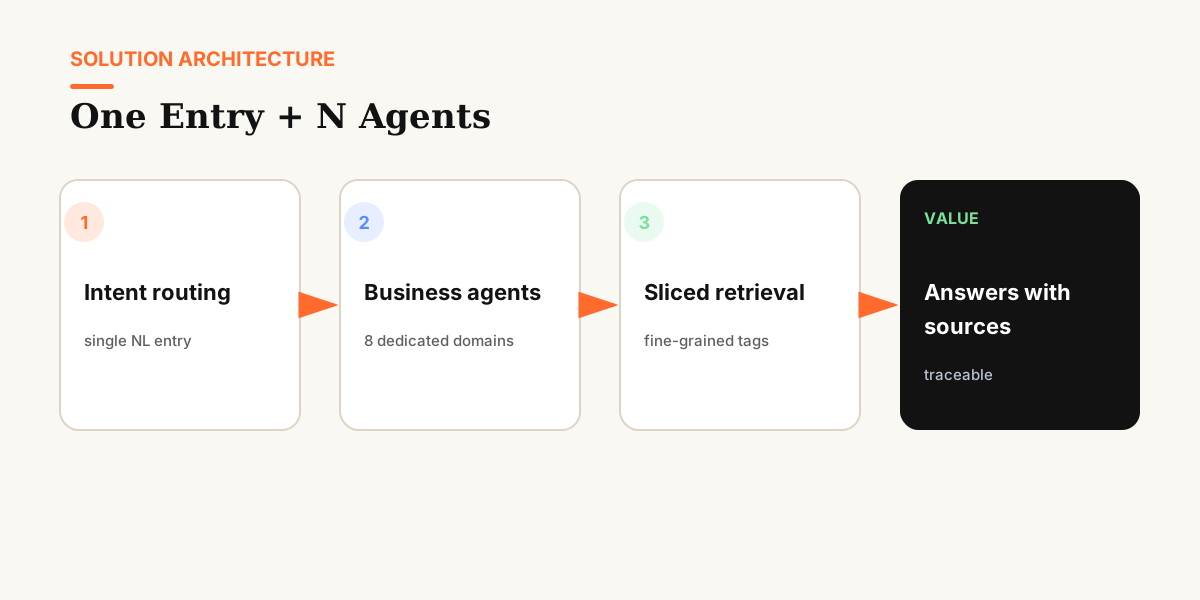
The project pursued three goals — "build completely, answer accurately, govern strictly" — through three core mechanisms.
First, a multi-agent collaboration architecture. We built a "single entry point + N business-specific agents" architecture: a master orchestration agent identifies user intent and automatically routes to the corresponding business department's agent, while knowledge bases remain mutually isolated and independently maintained, giving users a seamless, single-stop experience. The bank ultimately deployed dedicated knowledge agents across 8 business scenarios, running in parallel with clear boundaries.
Second, fine-grained document tagging and chunking. Heterogeneous documents were processed with platform-level automatic chunking, and every document was tagged with a dual-dimension label — access channel and knowledge type — ensuring order from the ground up. This "channel + type" system means retrieval both hits the right content and distinguishes its intended use.
Third, multi-channel permission routing. For different sources such as public network, intranet mobile, and intranet PC, the backend dynamically passes parameters and overlays channel-level permission filtering on top of multi-agent routing, strictly controlling the recall boundary and ensuring physically isolated protection of confidential documents. This directly matches the bank's complex intranet/extranet data separation requirements.
On the knowledge supply side, a dedicated knowledge consulting team worked on site: conducting structured interviews across all 26 departments to understand each department's knowledge landscape, use scenarios, and pain points; helping each department inventory its document assets and define unified classification standards and naming conventions; co-designing the bank-wide knowledge architecture covering layering, domains, permission ownership, and maintenance responsibilities; and finally guiding departments through document cleaning and ingestion, chunking rules, and dual-dimension tagging, with search tests validating knowledge quality. Institution-wide document collection and cleaning standards were also defined, prioritizing well-structured, highly searchable documents so the knowledge foundation was solid from the data entry point.
On the technical side, the platform was driven by twin engines — RAG and a knowledge graph. RAG chunks and vectorizes policy documents, supporting "ask and answer with precise provenance"; the knowledge graph makes relationships among policies, processes, roles, and departments explicit, supporting conditional filtering and multi-hop retrieval. Together they ensure answers come with sources and context.
Results
- One entry point, bank-wide coverage: knowledge is consolidated under a single interface; employees get accurate policy interpretations and operating guides in seconds through natural-language dialogue, breaking down departmental barriers.
- 8 business-specific agents: policy, culture, products, and other business scenarios each have a dedicated knowledge agent, routed automatically by the master agent with no user-visible friction.
- 26 departments achieved knowledge governance: the project pushed the whole bank to structurally govern historical knowledge documents, forming a high-quality, continuously iterable digital asset library — AI adoption and knowledge management upgraded in tandem.
- Security and compliance: the "channel tag + parameter routing" mechanism layers channel permission filtering, physically isolating confidential documents from the public channel and meeting the bank's intranet/extranet separation requirements.
- Knowledge visualization: statistical dashboards make knowledge-base usage and hot topics visible at a glance, supporting continuous operational improvement.
Lessons Learned: From Project to OntiCards
This project distilled three reusable lessons. First, "knowledge system first": the quality ceiling of AI Q&A is set by the level of knowledge governance — complete systematic surveys across 26 departments before talking about technical implementation. Second, "multi-agent does not mean multiple systems": a unified entry point, intent routing, and permission filtering keep business boundaries clear while keeping user experience consistent. Third, "dual-dimension tags are the balance point between security and usability": labeling both channel and knowledge type keeps knowledge open and controlled at the same time.
These lessons became OntiCards' solution capability for knowledge management in financial services: using Data Cards to carry the semantic representation of knowledge assets, and unified agent orchestration so knowledge is "built once and reused bank-wide." In an era where RAG is widely adopted, what really separates these projects is making retrieval more accurate, permissions stricter, and answers traceable — which is exactly the core problem OntiCards' four-layer architecture was designed to solve.