Three AI Agents, One Telecom Operator: Organizational Rollout
A provincial telecom operator deployed three focused AI agents — a public-opinion insight assistant, a sales agent, and a contract-review assistant — into the daily workflows of its marketing, sales, and legal departments, turning 'humans watch, humans chase, humans review' into 'machines watch, machines chase, machines review' and making operations, marketing, and risk control smarter.
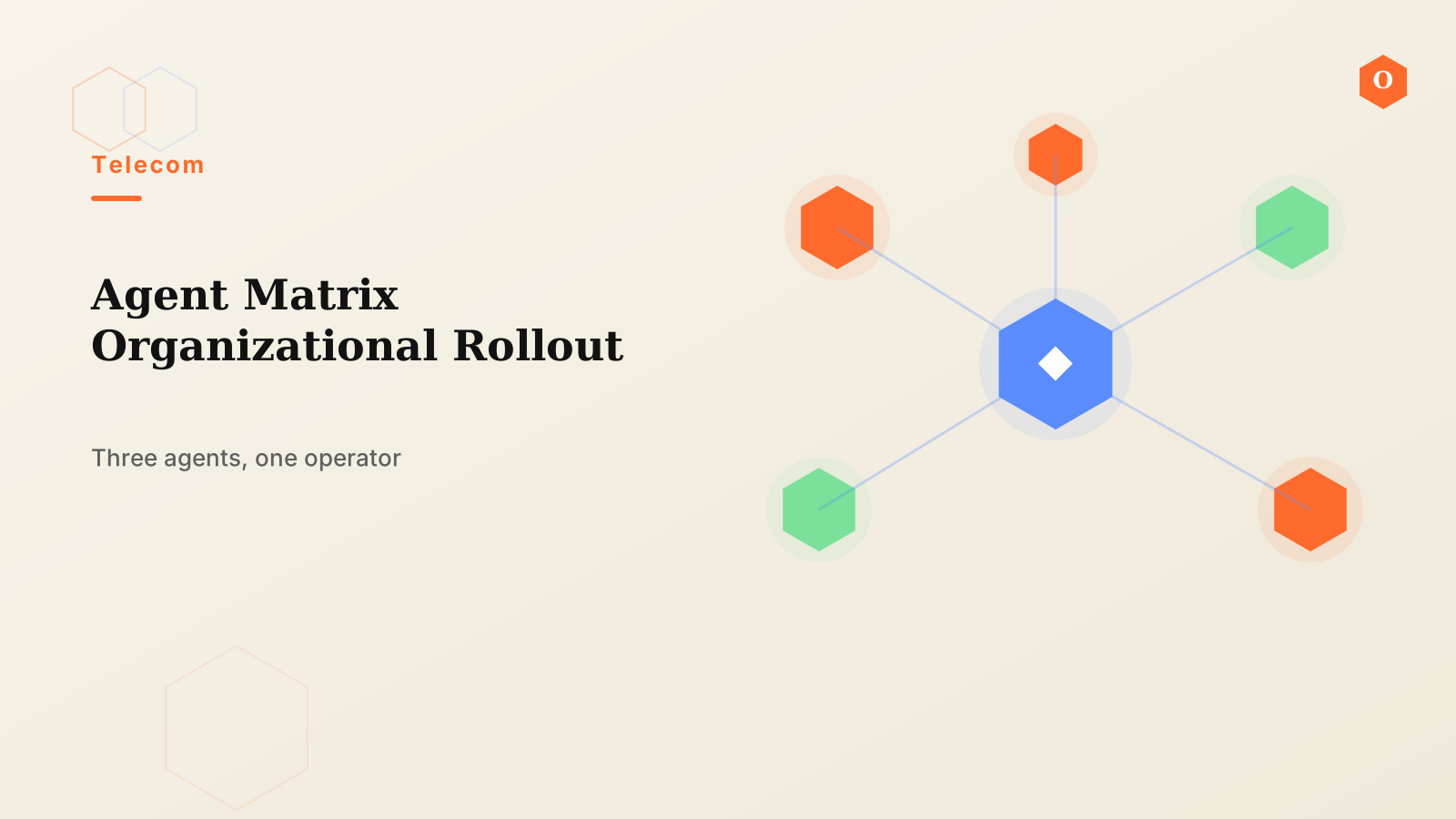
A provincial telecom operator is undergoing a quiet, organization-wide AI transformation — not by chasing one all-powerful super model, but by deploying three AI agents with clearly divided responsibilities: a public-opinion insight assistant, a sales agent, and a contract-review assistant, each embedded in the daily workflows of the marketing, sales, and legal departments. Three agents solve three kinds of problems, all pointing at the same goal: making operations, marketing, and risk control smarter.
Background and Pain Points
Telecom is a classic data-intensive industry — and one of the most exposed to the triple pressure of "inefficiency, manual dependence, and human error." Market decisions depend on external public opinion, which is scattered across news, social media, and complaint channels; manual collection is both delayed and one-sided. Sales leads must pass through heavy manual screening and phone calls before conversion, making the pipeline long. Contract review is the legal department's "manual labor": clauses are read line by line, standards are inconsistent, and omissions and mistakes are common. Industry research confirms the trend — in telecom, AI agents deliver measurable efficiency gains in well-bounded areas such as billing optimization, network operations, and anomaly detection, but the bottleneck is usually not model capability. It is whether data can be organized and whether business logic can be structured.
This operator's pain points were the classic "three lows, three highs": low efficiency, slow response, low error tolerance; high labor cost, high risk of inconsistent definitions, and high cost of mistakes in critical steps. The company needed a solution that did not rely on "throwing more people at it."
What We Did
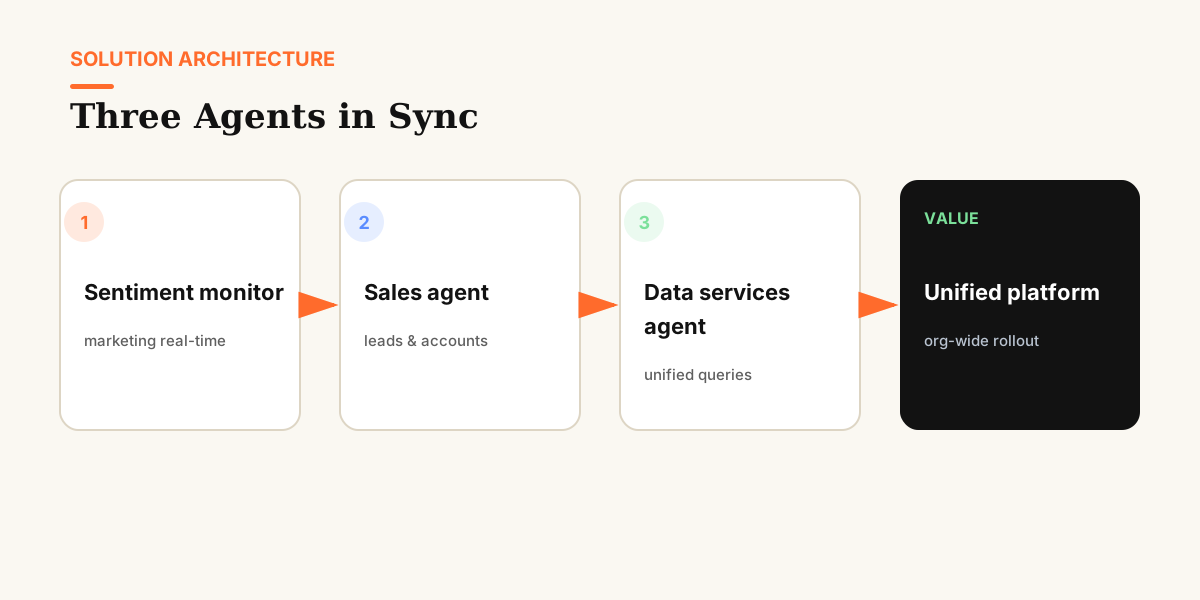
The project adopted a "general-purpose LLM + multimodal + data semantic layer" approach, building one agent per business department, each targeting a class of well-defined problems.
Public-opinion insight assistant — serving marketing. It continuously captures external opinion, classifies content, performs sentiment analysis, and assesses trends, outputting structured insights that give market decisions a timely basis. The marketing team no longer relies on manually browsing pages and compiling reports; it tracks the public mood through continuous agent monitoring.
Sales agent — serving sales. It automates lead tracking from generation and priority identification to follow-up reminders, reducing what gets missed in manual screening. It also recommends conversation scripts based on historical deal data and customer profiles, helping frontline sellers enter effective conversations faster.
Contract-review assistant — serving legal. It reviews contracts intelligently, automatically identifying key clauses, potential risks, and compliance points, and outputs structured review comments. Legal staff focus their energy on clauses that truly need professional judgment, keeping compliance risk under control.
The three agents run in parallel within the same organization, all backed by a unified approach to data ingestion and knowledge organization — different departments' data is structured under a consistent semantic layer, so the models produce stable, explainable outputs within their own scopes of action.
Results
- Opinion monitoring moved from "manual collection, delayed aggregation" to "automatic monitoring, real-time insight," giving market decisions a more timely foundation.
- Sales leads are automated from generation to follow-up, with fewer missed leads and better follow-up efficiency.
- Contract review moved from "line-by-line manual reading" to "intelligent identification plus human review," with unified standards and clearly fewer missed risks.
- The workflows of marketing, sales, and legal were all "taken over at the repetitive end, freed at the human end" — overall responsiveness and operational efficiency improved.
- The capability distilled into these agents gives the company a reusable foundation for extending to more business scenarios.
Lessons Learned: From the Project to OntiCards
The lesson of this project can be summed up in one sentence: an agent is not a point tool; it is an organizational capability. Whether it truly runs inside a department depends on three conditions — whether data can be ingested, whether business semantics are clearly defined, and whether outputs are stable and explainable. These three points are exactly the core problems that OntiCards' data cards and four-layer architecture are designed to solve: only when data ingestion and semantic definition are solid can agents perform reliably on the business side.
These lessons have been distilled into OntiCards' solution for telecom operators and large-enterprise intelligence transformation. Within our "Ingest, Cards, Ask, Consume" framework, we help enterprises build a unified semantic layer over internal knowledge, contracts, opinion, and other data, so that various agents run on a reliable data foundation. Visit the OntiCards website to see how we help companies move agents from "pilot" to "organization-wide rollout."